
A sowing window is the range of months when a crop can usually be sown in England, such as April to July for beetroot sown outdoors. It is a range to plan around, not a single date you must hit: you sow when the soil and weather suit, at any point inside the window.
Seed packets, books and planners all give windows, and they rarely agree to the week. This guide explains how to read them, why they differ and what moves them from year to year.
Ranges, not deadlines
Weather in England changes a lot from one spring to the next, so a window gives you room to wait for suitable conditions. A cold, wet March may mean sowing in April; a mild spring may let you start at the beginning of the window.
Windows also differ by source because they are written for different conditions. For beetroot, the RHS gives late March or April to July outdoors, while Kings Seeds lists March for 'Boltardy', but only with protection. Sowstory's knowledge base uses April to July for outdoor sowing, leaving out the protected early start. Both are right for the conditions they assume.
Three windows: sow, plant out and harvest
Many crops have more than one window, and it helps to know which one you are looking at.
| Window | What it means | Example from Sowstory's knowledge base |
|---|---|---|
| Sow | When seed goes in: outdoors, or indoors or in a tray | Parsnip: March to May outdoors |
| Plant out | When young plants go into their final place outdoors | Leek: sow March to May, plant out May or June |
| Harvest | When the crop is usually ready to pick | Brussels sprouts: September to February |
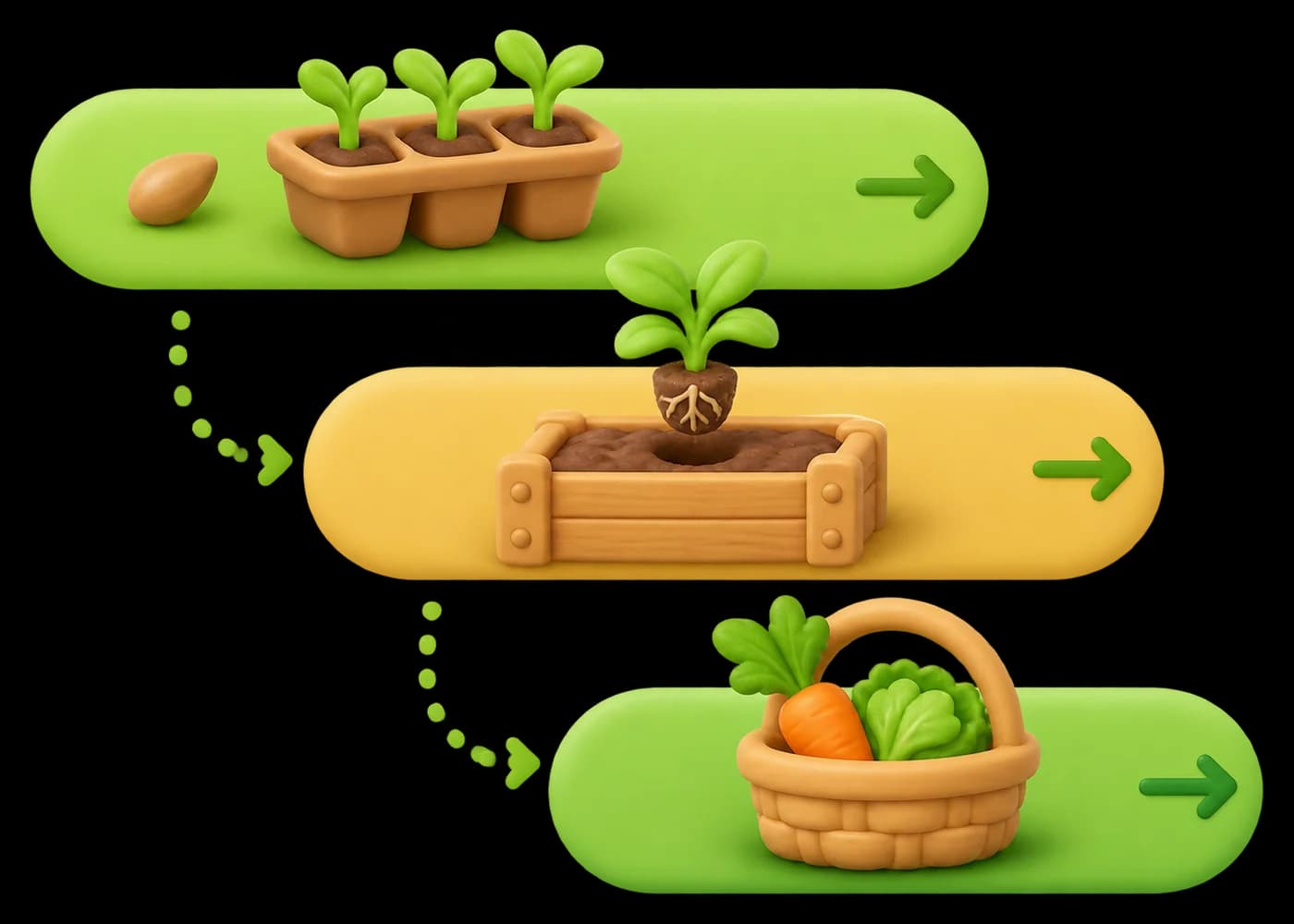
Some crops are sown straight into the bed, so the sowing window is the only one that matters. Others, such as leeks, tomatoes and Brussels sprouts, are sown in one place and planted out later, so the date they go into your raised bed is the planting window. Our vegetable sowing calendar shows both for every crop.
What moves a window where you live
The same window starts earlier in some places than others:
- Region. The south and coasts are usually earlier, the north, inland areas and high ground later.
- Shelter. Sheltered, urban or coastal gardens warm up sooner; exposed, rural or high sites later.
- Frost pockets. Cold air drains downhill and gathers in low spots, so a garden at the bottom of a slope can stay frosty for longer.
- Soil. The RHS limits February sowing outdoors to light soil in mild areas and suggests waiting until March or April elsewhere.
Tender crops and frost
For frost-tender crops such as tomatoes, courgettes, beans and peppers, the window that matters most is when it is safe to plant out. The RHS gives typical first safe times of the first to second half of May on the south-west tip and south coast of England, the second half of May in southern England, the end of May in the Midlands, north-west England and Yorkshire, and early June in north-east England. It suggests sheltered, urban or coastal sites can go one to two weeks earlier and exposed, rural or high sites should wait one to three weeks longer.
The RHS also says the last air frost usually comes two to four weeks before it is safe to plant tender crops out, and that nights should be consistently above 7°C, or above 10°C for tomatoes, peppers, basil and courgettes. Our guide to the last frost date in the UK explains why there is no reliable single date for your postcode.
How to read a window in practice
- Check where you are in the window. Early in the window, the soil may still be cold and wet; late in it, the crop has less time to grow.
- Look at the soil and the forecast. If the ground is waterlogged, frozen or cold, wait.
- Sow when conditions suit, any time within the window. For crops planted out, harden off indoor-raised plants first; the RHS says this takes two to three weeks.
For month-by-month lists, start with what to sow in March, when the main outdoor sowing season begins for many crops.
How Sowstory uses windows
Sowstory's knowledge base gives each crop the months when it can start in the bed in England, whether that is sowing direct or planting out. These are England-wide months, chosen to be on the safe side; they are not adjusted to your postcode's local climate, and Sowstory does not calculate a frost date for your address. You still judge the weather on the day.
When you plan a bed, each crop starts in the first of its months that falls in your season, so early crops such as peas can go in while tender crops wait for June. You can see how this works in how Sowstory lays out a bed, and you will need your bed's measurements to start.
If you would like every crop's start month worked out for your own bed, Sowstory gives a month-by-month plan alongside the layout. It works in your web browser now, and your first bed plan is free.