
Sowstory lays out a raised bed by placing each crop either as a row with a measured length or as individual plants with their own space, using the exact size of your bed. Tall crops go on the north edge, every crop starts in the month it can reliably go in, and any crop that does not make it into the plan is listed with the reason.
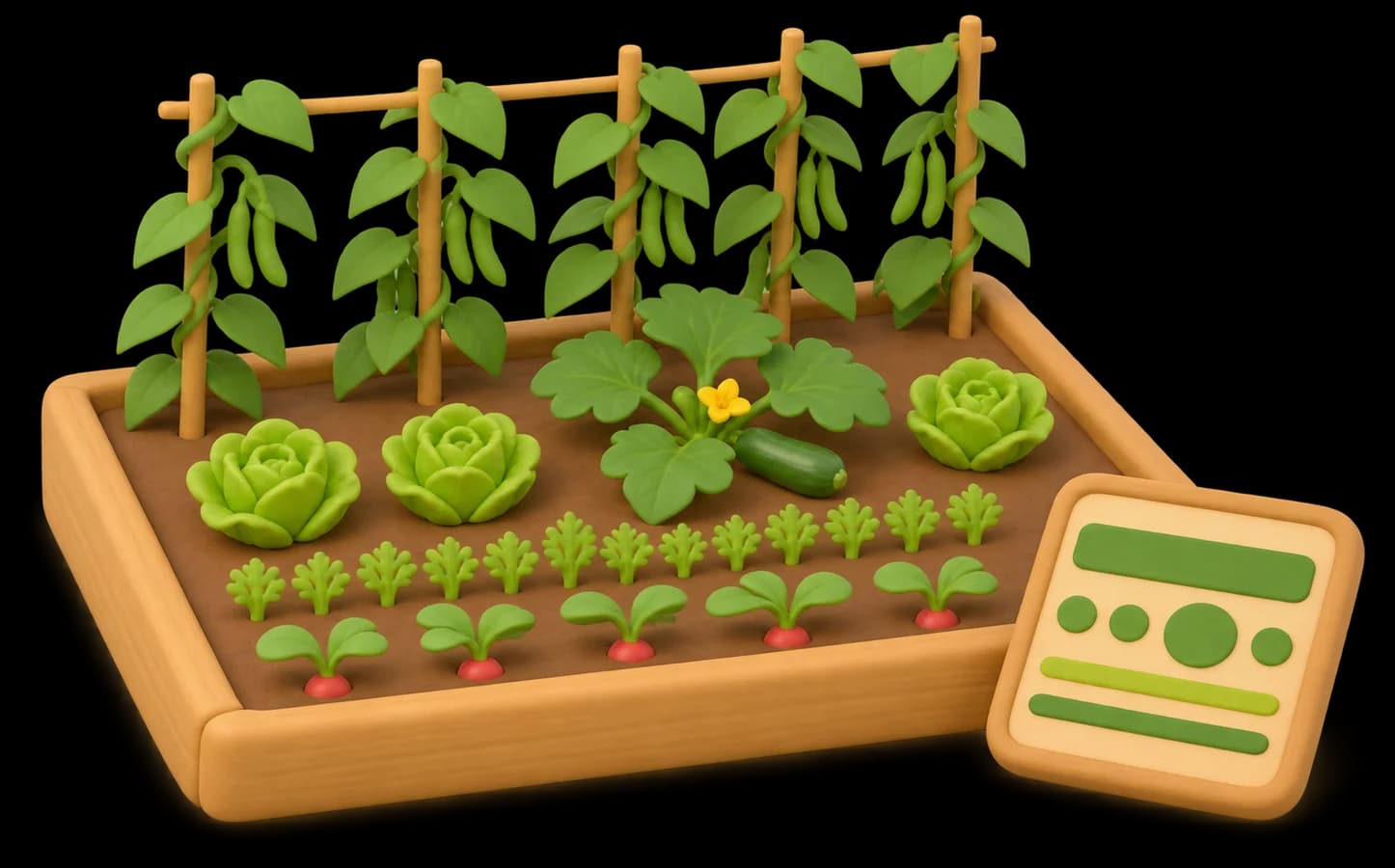
This guide explains what the planner asks you, how it decides where things go, and what it does not do yet. If you are planning by hand instead, our raised bed layout guide uses the same spacing rules.
What Sowstory asks you
The planner works from a few facts about your bed and how you like to garden:
- Bed size. The inside length and width, to 0.1 cm. See how to measure a raised bed.
- Which edge faces north. So tall crops can be kept from shading shorter ones.
- Your England postcode. Used to place the bed in England; the full postcode is not stored.
- Direct sun. Mostly shade (under 4 hours), part sun (about 4–6 hours), sunny (about 6–8 hours) or full sun (more than 8 hours).
- When you want to start. The month the season begins.
- The crops you like or want to avoid. You can ask for a crop, set how much of it you want, or exclude it.
- Your goal and experience. Easiest, maximum variety or continuous harvest; beginner or returning gardener.
- What you can do. Whether you can start crops indoors or buy young plants, whether you accept a stake or trellis, and, optionally, how deep the soil is.
Rows and individual plants
Crops are not all planted the same way, so Sowstory does not treat every crop as one plant on a grid.
- Row crops, such as carrots, radishes, spinach, onions and peas, are planned as rows. Each row has a length and a corridor of space around it, so neighbouring rows never overlap. The plan tells you how long each row is; you sow thinly along it and thin out as the seedlings grow.
- Single-plant crops, such as head lettuce, courgettes, cabbages and tomatoes, each get their own measured footprint, and the plan shows exactly where every plant goes.
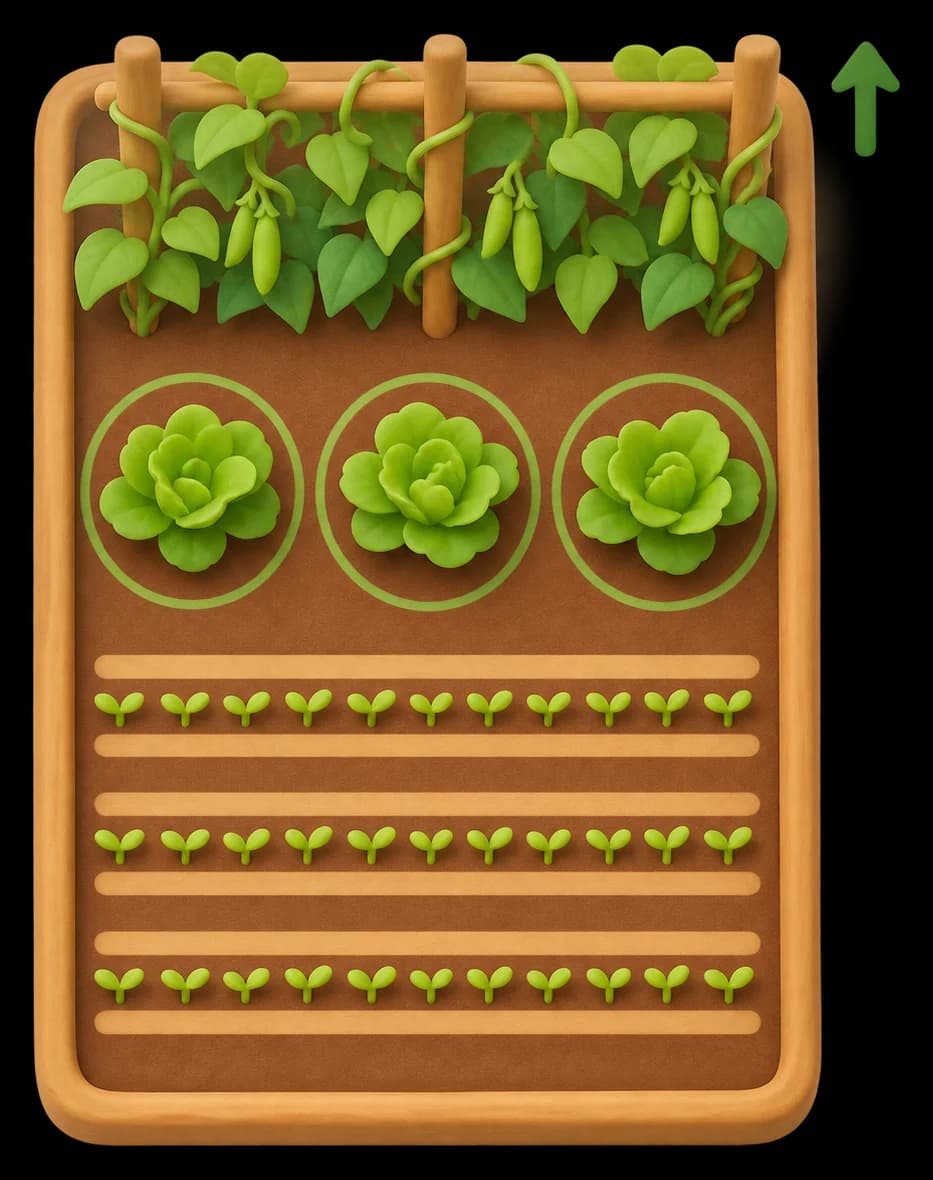
Positions are measured from the south-west corner of the bed, so you can mark them out with a tape. The spacings come from Sowstory's knowledge base, which takes them from published sources such as the RHS and seed suppliers and often uses the more generous figure; our plant spacing chart lists them crop by crop.
Tall crops on the north edge
Runner beans, climbing French beans, cordon tomatoes, tall kale and other tall crops are placed along the north edge. In England the sun is to the south, so a tall row on the north side throws its shadow outside the bed instead of over the shorter crops in front. Crops that need a cane or trellis are only planned if you have said you accept a support.
Crops that suit your bed and season
Before placing anything, Sowstory checks each crop against your bed:
- Sun. Some crops need at least six hours of direct sun; others cope with four to six. Every crop in the knowledge base needs at least four hours, so a bed in deep shade gets a plain message naming the crops that cope best.
- Soil depth. A few crops have a minimum depth, such as 30 cm for early carrots and first early potatoes. If you leave the depth blank, those crops are left out and the plan asks you to enter it.
- Indoor start. Crops such as leeks, tomatoes, cabbages and kale go in as young plants. They are planned only if you can raise or buy them.
- Timing. Each crop starts in the bed in its own months for England, which the next section explains.
Staged start dates through the season
A season runs from the month you choose and the three months after it. Each crop starts in the first month in that season when it can reliably go into the bed in England, so peas and early potatoes can start in March or April while French and runner beans and courgettes wait until frost risk has passed. If you choose a winter month, the plan starts the spring crops from 1 March.
Where the timing allows, a second crop can go into the same spot once the first is cleared. The dates are England-wide and deliberately on the safe side; they are not adjusted to your street's weather. Our guide to sowing windows explains how to read them.
Your goal decides what fills the space
The crops you ask for come first, and each is grown up to a sensible maximum for a bed of that size. If you let Sowstory fill the rest of the bed, it suggests crops in an order set by your goal:
- Easiest: familiar crops that need no support or indoor start.
- Maximum variety: as many different crops as fit, compact ones first.
- Continuous harvest: quick crops you can pick from early on, with later ones following.
Beginners get familiar, forgiving crops first. Suggestions never include a second version of a crop you already chose, and you can turn off filling so the leftover soil stays free for your own ideas.
If you would like to see the layout for your own bed, Sowstory will place every row and plant to scale and give you a month-by-month plan. It works in your web browser now, and your first bed plan is free.
Every trade-off explained
When not everything fits, the plan lists each crop you chose that is not in it, with a plain reason. Typical reasons include:
- It needs more direct sun than this bed gets.
- It needs deeper soil than you entered.
- It needs a support or trellis.
- It needs to be started indoors or bought as young plants.
- It can't be started reliably in this plan's season.
- The bed is too narrow for this crop's rows, or there was no room left after the other crops.
Each reason points to something you can change: the sun setting, the depth, the support option, the start month or your crop choices. The planner is deterministic, so the same answers always give the same plan, and it never makes up a plan when nothing fits.
What Sowstory does not do yet
- It plans 35 crops (45 growing profiles) for outdoor raised beds in England. Sweetcorn, squash and pumpkins, strawberries and trailing cucumbers are not planned yet.
- Dates are England-wide months, not adjusted to your postcode's local climate, and it does not calculate a frost date for your address. You still judge the weather.
- It does not plan repeat sowings of the same crop, autumn-sown broad beans, or crop rotation across years.
- Spacings are planning allowances; varieties differ, so check the seed packet too.
Sources
- RHS: Raised beds
- Sowstory knowledge base, release v1.4