
Succession planting means keeping a bed in use all season: you sow small batches of quick crops every few weeks, and put a new crop into each gap as soon as the last one is cleared. In England the RHS suggests outdoor sowings from mid-spring to late summer, usually about a fortnight apart, though anything from one to four weeks can suit.
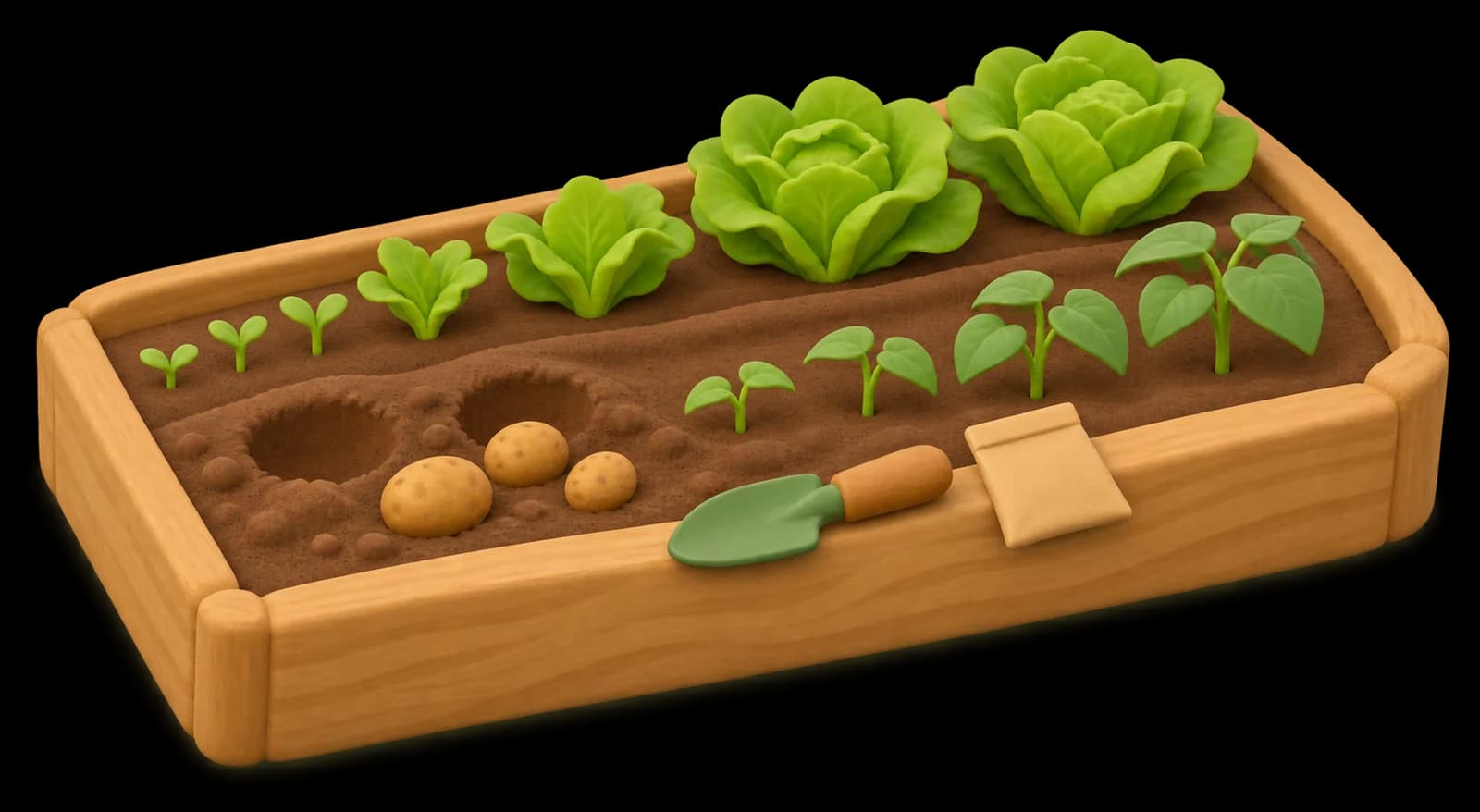
For a raised bed, where every strip of soil counts, it is the simplest way to get more from the same space. This guide covers which crops suit it, how often to sow, what can follow early potatoes and peas, and an example year for one 1.2 × 2.4 m bed.
Succession planting at a glance
| Question | Answer |
|---|---|
| What it is | Repeat sowings in small batches, and new crops in cleared space |
| Usual interval | About two weeks; one to four weeks outdoors (RHS) |
| Season | Mid-spring to late summer outdoors (RHS) |
| Best crops | Lettuce, radish, carrots, peas, French beans, spinach, rocket, beetroot |
| Rarely needed | Onions, leeks, tomatoes, peppers, aubergines, pumpkins, Brussels sprouts (RHS) |
| Quick follow-on crops | Lettuce and radish can start in the bed until August (Sowstory) |
What is succession planting?
The term covers a few related ideas:
- Successional sowing. The RHS describes it as repeated sowings of one crop in small batches, so you get a steady harvest instead of a glut. The RHS lettuce guide, for example, suggests a short row every two weeks.
- Follow-on crops. When an early crop such as first early potatoes or spring-sown peas comes out, a different crop goes into the same space for the rest of the season.
- Catch crops and intercropping. The RHS describes a catch crop as a fast crop grown between plantings of a main crop, and intercropping as growing another crop in the space between rows. Its radish guide suggests sowing radishes between slower crops such as peas and potatoes.
The RHS adds that these methods can be used without upsetting a crop rotation, and that salads can go wherever there is room.
Which crops suit succession sowing?
The RHS picks out quick-maturing vegetables: carrots, French beans, peas, salads and spinach. For crops that bolt (run to seed) easily, such as coriander, rocket and spinach, it calls successional sowing especially important, because each batch has a short useful life.
Longer-cropping plants such as courgettes and runner beans can be grown in two batches for autumn production. Some crops rarely need it at all: the RHS lists aubergines, peppers, tomatoes, onions, pumpkins, Brussels sprouts and leeks.
Succession planting intervals by crop
The table puts the source intervals beside Sowstory's planning values. "Start months" are when the crop can go into the bed in Sowstory's England plan. "Space reserved" is how long Sowstory holds the row for one batch (explained below).
| Crop | Sowstory start months | Space reserved per batch | How often to sow (source) |
|---|---|---|---|
| Lettuce (loose-leaf) | March to August | About 10 weeks | A short row every fortnight, late March to late July (RHS) |
| Radish | March to August | About 8 weeks | Small batches every few weeks (RHS) |
| Carrots (early) | March to July | About 12 weeks | Every three to four weeks (RHS) |
| Beetroot | April to July | About 16 weeks | Short rows every few weeks (RHS) |
| Peas (dwarf) | March to June | About 17 weeks | Small batches every few weeks (RHS) |
| Dwarf French beans | June | About 14 weeks | Several sowings, late spring to midsummer (RHS) |
| Annual spinach | March to May, August to September | About 10 weeks | Every few weeks in spring and late summer (RHS) |
| Salad rocket | March to May, August | About 14 weeks | Successional sowing especially important (RHS) |
| Pak choi | May to August | About 11 weeks | In succession (Sowstory) |
Each crop's own guide goes further: see how to grow lettuce, how to grow radishes and how to grow beetroot.
When to sow the next batch
A fixed timetable is a starting point, not a rule. The RHS suggests sowing the next batch once the previous one is well developed: when leafy crops have about four true leaves, when peas are about 5 cm high and when beans are about 10 cm tall. Weather changes the pace, too. The RHS says lettuce may need sowing only every three weeks in early spring but as often as once a week in warm, moist summer weather.
What does "space reserved" mean?
Sowstory gives every crop a bed occupancy: the number of days it holds that strip of the bed, from sowing or planting until the row is cleared. It is a planning allowance, not a promise of when you will harvest. For loose-leaf lettuce it is 70 days (10 weeks), for radish 56 days (8 weeks) and for beetroot 112 days (16 weeks), which covers getting the row going and picking over several weeks.
That number is what makes succession work on paper. Add it to the start date and you know roughly when the space is free, then check whether the next crop's start months are still open. Our guide to sowing windows explains how to read the months themselves.
Following one crop with another
Succession planting potatoes
There are two ways to use succession with potatoes.
- Stagger the types. The RHS plants first earlies in late March, second earlies in early to mid April and maincrops from mid April to early May, and lifts them from June to July, July to August and late August to October. A few of each spreads the harvest.
- Follow the earlies. Sowstory reserves space for first earlies for about 12 weeks (84 days). The RHS says earlies free their ground by midsummer for a later crop such as courgettes or beans, and Gardeners' World suggests carrots, leeks or brassicas.
Timing decides which follow-on crops fit. First earlies planted in early March are reserved until about early June, in time for Sowstory's June windows for leeks, courgettes and dwarf French beans. Planted in late April, they hold the row until about late July, when beetroot and carrots (to July) and lettuce and radish (to August) still fit. See how to grow potatoes for planting and harvest.
Succession planting after peas
Dwarf peas sown in March hold their row for about 17 weeks (119 days) in Sowstory's plan, so the space is usually free in July. In Sowstory's windows, beetroot, carrots, kohlrabi, lettuce, radish, baby turnips and pak choi can all start then, and sprouting broccoli plants can go in during July or August. For more on peas, see how to grow peas.
Succession planting green beans
The RHS says dwarf French beans start cropping in about eight to ten weeks but only crop for a few weeks, so it suggests several sowings from late spring to midsummer. They are tender: sow outdoors only once frost risk has passed, which the RHS puts between the first half of May on the south coast and early June in north-east England. Our guide to the last frost in your area explains how to judge it. Sowstory plans a single June start for dwarf French beans, so any later sowings are your own addition.
Pairings that do not fit
Not every early crop can be followed by every later one. Dwarf broad beans sown in March hold their row for about 22 weeks (154 days) in Sowstory's plan, which takes them into August. By then the June window for dwarf French beans has closed, so follow broad beans with crops that can still start in August: lettuce, radish, spinach, salad rocket, baby turnips or pak choi.
Succession planting in a vegetable garden: an example year
Here is one way to use a 1.2 × 2.4 m bed (about 4 × 8 ft), with rows along the 2.4 m length, using Sowstory's row widths and bed occupancy.
Strip 1 (90 cm wide):
| Crop | Goes in | Space reserved | Free again about |
|---|---|---|---|
| First early potatoes, 8 tubers (240 ÷ 30 cm) | Early March | 12 weeks | Early June |
| Dwarf French beans, 12 plants (240 ÷ 20 cm) | June | 14 weeks | September |
| Garlic, 3 rows of 16 cloves | October to December | 36 weeks | The following summer |
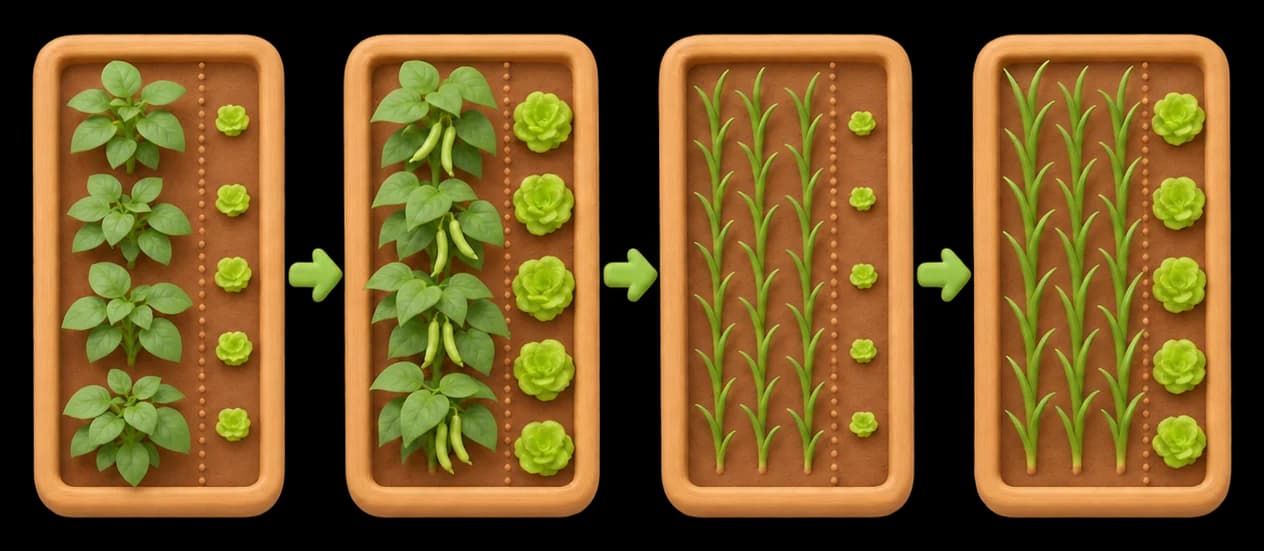
Strip 2 (25 cm wide), loose-leaf lettuce: 90 + 25 = 115 cm, which fits inside the 120 cm width. Each lettuce batch holds its space for about 10 weeks, so three batches sown in mid-March, late May and early August (the last month in Sowstory's lettuce window) keep the strip cropping until about October: 3 × 10 weeks is 30 weeks.
To follow the RHS fortnightly rhythm instead, split the 2.4 m row into four 60 cm sections and sow one section every two weeks. At 15 cm apart, each section holds four plants.
The garlic step needs some forethought, as it ties up the strip until the following summer: see when to plant garlic. If the potatoes go in later, in April, swap the French beans for beetroot or lettuce, as above. The raised bed layout guide shows other ways to divide a bed, and the vegetable sowing calendar gives each crop's months.
Working out what follows what, and when each strip comes free, is the fiddly part. Sowstory lays out your bed to scale, tells you how many plants or rows fit and gives a month-by-month timing plan, including succession where supported. It works in your web browser now, and your first bed plan is free.
Succession planting in containers
The RHS notes that containers can be used where space is short. Quick crops such as loose-leaf lettuce and radish are the obvious candidates: sow a pot every few weeks, so a new one is coming on as the last one finishes. The same RHS cue applies, sowing the next batch when leafy crops have about four true leaves.
Common succession planting problems
- Batches that catch up with each other. The RHS warns that swings in the weather can make sowings two weeks apart mature together. Sowing when the previous batch reaches the right stage helps.
- Bolting. Crops can run to seed if sown too early, stressed when transplanted or short of water, according to the RHS.
- Pests on young sowings. The RHS mentions aphids, especially on beans, and slugs and snails on seedlings. It also says carrot fly hits early and late carrot sowings harder than midsummer ones.
- Tired soil. When sowing in late summer where a crop has already been lifted that year, the RHS suggests working in a general-purpose fertiliser first.
What Sowstory plans, and what it does not
Sowstory's start months are England-wide; they are not adjusted for your postcode, and the app does not give a frost date for your address. The south and coasts are usually earlier, and the north, inland gardens and high ground later, so you still judge the weather before each sowing. Spacings and bed occupancy are planning allowances drawn from published guidance, and varieties differ, so check the packet. The plant spacing chart lists the row widths used above.
Sources
- RHS: Successional sowing
- RHS: Planning a vegetable garden
- RHS: How to grow lettuce
- RHS: How to grow radishes
- RHS: How to grow carrots
- RHS: How to grow beetroot
- RHS: How to grow peas
- RHS: How to grow French beans
- RHS: How to grow spinach
- RHS: How to grow potatoes
- Gardeners' World: How to grow potatoes
- RHS: When to plant out tender plants
- Sowstory knowledge base, release v1.4