
The easiest vegetables to grow in the UK for a first raised bed in England are quick crops sown straight into the soil, such as radishes, loose-leaf lettuce, spring onions, beetroot and chard, plus potatoes, onion sets and garlic planted straight in. Most can start in the bed in March or April; courgettes and dwarf French beans wait until frost risk has passed, which the RHS puts between May on the south coast and early June in north-east England.
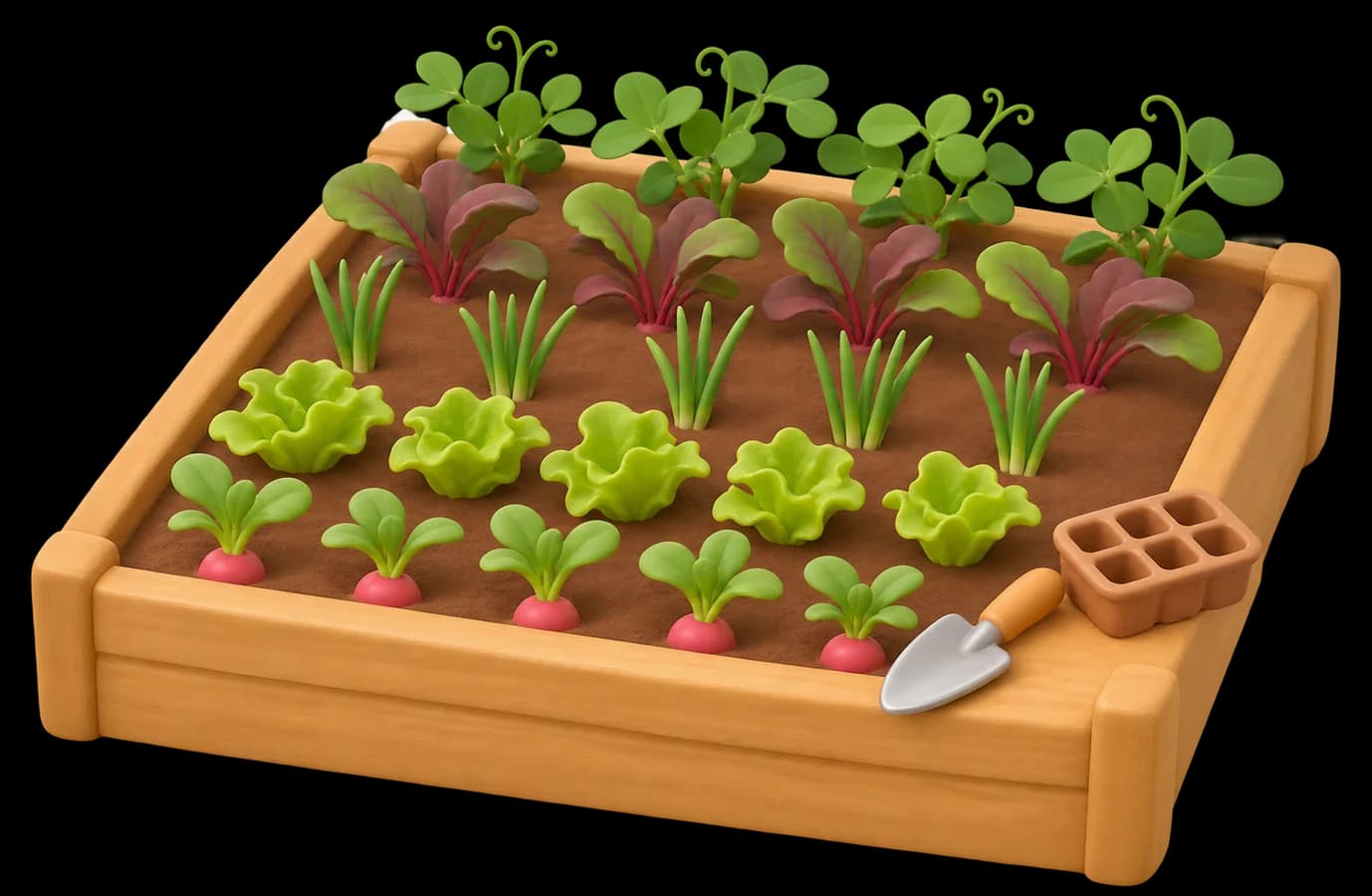
This guide is for your very first bed. It lists 11 crops that the RHS or Gardeners' World describe as easy or suited to beginners, gives Sowstory's planning values for each, then shows a simple first-bed plan, a February to May timeline and the crops to leave until later. For a wider list of 20 crops for any raised bed, see what to grow in a raised bed.
Easy vegetables to grow in the UK: the shortlist
Every crop here is called easy, simple or good for beginners by the RHS or Gardeners' World, and each one is sown or planted straight into the bed. The months are when Sowstory lets you start the crop in the bed in England. "Space reserved" is how long Sowstory plans the bed space as busy, from sowing or planting to clearing; it is not a promised harvest date.
| Crop | Starts in the bed | Spacing (Sowstory) | Space reserved | Sun |
|---|---|---|---|---|
| Radish | March–August | rows 15 cm, plants 2.5 cm | about 8 weeks | 4–6 hours |
| Loose-leaf lettuce | March–August | rows 25 cm, plants 15 cm | about 10 weeks | 4–6 hours |
| Spring onions | March–August | rows 10 cm, plants 8 cm | about 10 weeks | 4–6 hours |
| Chard | March–July | 30 × 45 cm per plant | about 20 weeks | 4–6 hours |
| Beetroot | April–July | rows 30 cm, plants 10 cm | about 16 weeks | 6+ hours |
| Dwarf peas | March–June | rows 60 cm, seed 7.5 cm apart | about 17 weeks | 6+ hours |
| First early potatoes | March–April | rows 90 cm, tubers 30 cm | about 12 weeks | 6+ hours |
| Onion sets | March–April | rows 25 cm, sets 10 cm | about 24 weeks | 6+ hours |
| Dwarf French beans | June | rows 50 cm, plants 20 cm | about 14 weeks | 6+ hours |
| Bush courgette | June | 90 × 90 cm per plant | about 20 weeks | 6+ hours |
| Garlic | October–December | rows 25 cm, cloves 15 cm | about 36 weeks | 6+ hours |
Spacings are Sowstory's planning allowances, usually the more generous published figure. Varieties differ, so check the packet. The vegetable spacing chart covers every crop Sowstory plans.
Why these crops are easy
Quick salads: radishes, lettuce and spring onions
The RHS calls salad radishes quick and easy to grow from seed, ready in as little as four weeks, or six to eight weeks from early sowings. It says lettuces and salad onions are easy to grow too. Loose-leaf lettuce can be picked as cut-and-come-again leaves from about four to six weeks, and spring onions are ready in about two months. All three tolerate four to six hours of sun in Sowstory's plans, and Gardeners' World notes that salad leaves do better in partial shade, as full sun can make them bolt. See how to grow radishes and how to grow lettuce.
Chard and beetroot
The RHS calls chard easy to grow from seed and says that once it is established it needs little beyond weeding; a spring sowing gives repeated pickings right through the summer. The RHS sows it outdoors from April to July, while Sowstory's window starts in March. Gardeners' World puts beetroot on its beginners' list, and both it and the RHS recommend the bolt-resistant 'Boltardy', which the RHS suggests for early sowings. The RHS says beetroot is usually ready in 50 to 60 days. See how to grow beetroot.
Peas and dwarf French beans
Gardeners' World suggests a compact pea that needs no staking, and Sowstory plans dwarf peas without support. The RHS still grows dwarf varieties up twiggy pea sticks, so a few sticks do no harm. Gardeners' World says dwarf French beans need no thinning or supports. They are tender, so Sowstory sows them in June. See how to grow peas.
Potatoes, onion sets and garlic
These are not grown from seed, which is part of why they are easy. Gardeners' World lists potatoes for beginners, planted in the ground or even an old compost bag. The RHS calls onion sets the easiest and quickest way to grow onions, and garlic simple to grow. See how to grow potatoes, how to grow onions and how to grow garlic.
Courgette
The RHS says courgettes are easy to grow, but each one grows big and vigorous, taking roughly a square metre, with at least 90 cm between plants. Sowstory plans at most two in one bed, and one plant takes most of a 1.2 × 1.2 m bed.
Easiest vegetables to grow from seed
If you want to start from a packet of seed, the simplest are those sown straight into the bed in spring: radishes, loose-leaf lettuce, spring onions, chard and beetroot. Dwarf peas follow in March or April. Dwarf French beans and courgettes are easy from seed too, but only once the soil is warm: the RHS sows courgettes outdoors in late May or early June.
A simple first-bed plan for a 1.2 × 2.4 m bed
This plan uses only spring crops from the shortlist, with rows along the 2.4 m length. The strip widths are Sowstory's row allowances and must add up to no more than the 120 cm inside width. Plants per row are the 240 cm row length divided by the in-row spacing, rounded down.
| Row, north to south | Crop | Strip width | In-row spacing | Plants per row | Start |
|---|---|---|---|---|---|
| 1, north edge | Dwarf peas | 60 cm | 7.5 cm | 240 ÷ 7.5 = 32 seeds | March–April |
| 2 | Beetroot | 30 cm | 10 cm | 240 ÷ 10 = 24 | April |
| 3 | Spring onions | 10 cm | 8 cm | 240 ÷ 8 = 30 | March–April |
| 4 | Radishes | 15 cm | 2.5 cm | 240 ÷ 2.5 = 96 | March |
| Total | 115 cm of 120 cm |
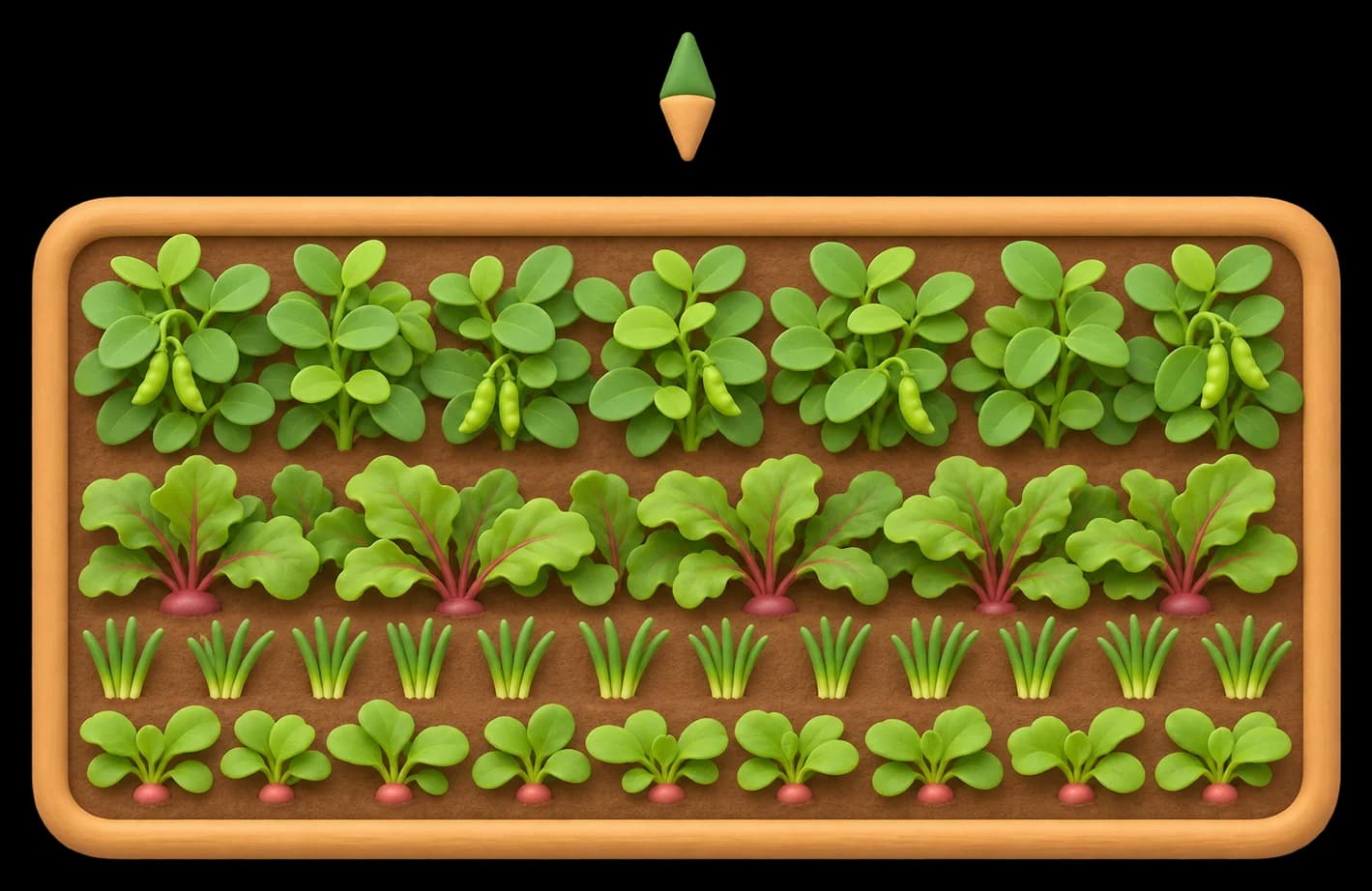
Sowstory does not count dwarf peas as tall, but they are the tallest row in this bed, so the north edge keeps their shade off the rest.
How the bed changes through the summer:
- Radishes hold their strip for about eight weeks, so you can sow again as each row is cleared, up to August.
- Peas hold their strip for about 17 weeks, so a March sowing clears in July. The 60 cm strip then takes two rows of loose-leaf lettuce (2 × 25 = 50 cm), which Sowstory starts up to August.
- Spring onions can be resown little and often until August.
Prefer potatoes? Swap the peas and beetroot (60 + 30 = 90 cm) for one row of first early potatoes, which takes a 90 cm strip and fits 240 ÷ 30 = 8 seed tubers. The total stays at 115 cm. Sowstory checks for at least 30 cm of soil before it plans potatoes; see how deep a raised bed should be.
If you would rather not work out the rows by hand, Sowstory takes your bed's size, how much sun it gets and the crops you like, then lays the bed out to scale, tells you how many plants fit and gives a month-by-month plan. It works in your web browser now, and your first bed is free.
Best vegetables to plant in spring: a February to May timeline
Sowstory's months are England-wide; the south and coasts are usually earlier, and the north, inland and high ground later. Sowstory does not adjust them for your postcode, so you still judge the weather.
- February. Sowstory starts nothing in the bed yet. The RHS limits outdoor sowing to light soil in mild areas and says to wait for the soil to warm elsewhere. Fill and level the bed, and chit early seed potatoes: the RHS stands them in a cool, bright, frost-free place from late January in milder areas or by early March in colder ones. See what to sow in February.
- March. Sow radishes, lettuce, spring onions, chard and dwarf peas, and plant onion sets and first early potatoes. The RHS plants first earlies in late March, and advises covering early sowings with cloches or fleece and protecting seedlings from slugs. See what to sow in March.
- April. Sow beetroot once the soil reaches at least 7°C, which the RHS says is from late March or April, and keep sowing salads in short rows. Gardeners' World plants onion sets from mid-March to mid-April. See what to sow in April.
- May. Earth up potatoes when the shoots reach about 23 cm, as the RHS advises. Hold back tender crops: the RHS gives the first to second half of May for the south-west tip and south coast, the second half of May for southern England, the end of May for the Midlands, north-west England and Yorkshire, and early June for north-east England. Sheltered, urban or coastal sites can be one to two weeks earlier, and exposed, rural or high sites one to three weeks later. Sowstory plans dwarf French beans and courgettes from June. See what to sow in May and our guide to last frost dates.
Garlic is the exception: it goes in from October to December, so if you are reading this in autumn, it is the one easy crop you can plant now.
Starting a garden: the few things that matter
If you are starting a vegetable garden from scratch, three choices decide most of the result:
- Sun. The RHS defines full sun as more than six hours of direct sun a day at midsummer. Most crops on the shortlist want that; radishes, lettuce, spring onions and chard manage with four to six hours in Sowstory's plans.
- Bed width and depth. The RHS keeps beds under 1.5 m wide so you can reach the middle without standing on the soil. Sowstory checks for at least 30 cm of soil before it plans first early potatoes and 20 cm for radishes.
- Soil. Gardeners' World advises clearing weeds and adding well-rotted compost or manure. Our guide on how to fill a raised bed works out the volumes.
Our beginner's guide to a raised bed vegetable garden covers siting, building and a first-year plan in more detail.
What to leave until later
These crops are worth growing, but they are harder for a first bed:
- Aubergines. Gardeners' World says they can be tricky and suggests trying them in your second year.
- Peppers and chillies outdoors. The RHS says shelter is essential for peppers, and Sowstory treats outdoor peppers and chillies as low confidence, needing a warm, sheltered spot. Gardeners' World does list a chilli for beginners, but grown in a container on a windowsill or in a warm, sunny spot.
- Cordon tomatoes. Gardeners' World says bush tomatoes are easier, because they need no support or side-shoot pinching. The RHS plants tomatoes out only once temperatures are reliably above 16°C. See how to grow tomatoes.
- Long-season brassicas. The RHS says broccoli takes four to ten months to start cropping and advises keeping it under insect-proof mesh or fleece at all times. Sowstory reserves space for Brussels sprouts for about 30 weeks and sprouting broccoli for about 40. See how to grow broccoli.
- Carrots in poor soil. The RHS warns that stony, shallow or heavy soil distorts long-rooted carrots, and that thinning releases a scent that draws carrot fly. Short-rooted types are easier. See how to grow carrots.
- Parsnips. They are slow to germinate, and Sowstory reserves their row for about 34 weeks.
Gardeners' World's general advice for beginners is to follow the spacing on the packet and grow only what you have room for.
Sources
- RHS: How to grow radishes
- RHS: How to grow lettuce
- RHS: How to grow salad onions
- RHS: How to grow chard
- RHS: How to grow beetroot
- RHS: How to grow peas
- RHS: How to grow potatoes
- RHS: How to grow onions
- RHS: How to grow garlic
- RHS: How to grow courgettes
- RHS: How to grow broccoli
- RHS: How to grow carrots
- RHS: Carrot fly
- RHS: How to grow tomatoes
- RHS: Grow your own, jobs for February, March and May
- RHS: When to plant out tender plants
- RHS: How to make a raised bed
- RHS: Shade gardening
- RHS: Positioning vegetables
- BBC Gardeners' World: Beginner veg to grow
- BBC Gardeners' World: Low-maintenance veg and fruit
- BBC Gardeners' World: How to grow onions
- Sowstory knowledge base, release v1.4