
Crop rotation means growing each family of vegetables in a different bed each year, so the pests and diseases that attack that family have no host to build up on. In England the usual plan follows the RHS: three beds holding potatoes, then legumes with onions and roots, then brassicas, with each group moving on one bed a year. November is a good time to draw it up, before you order seed.
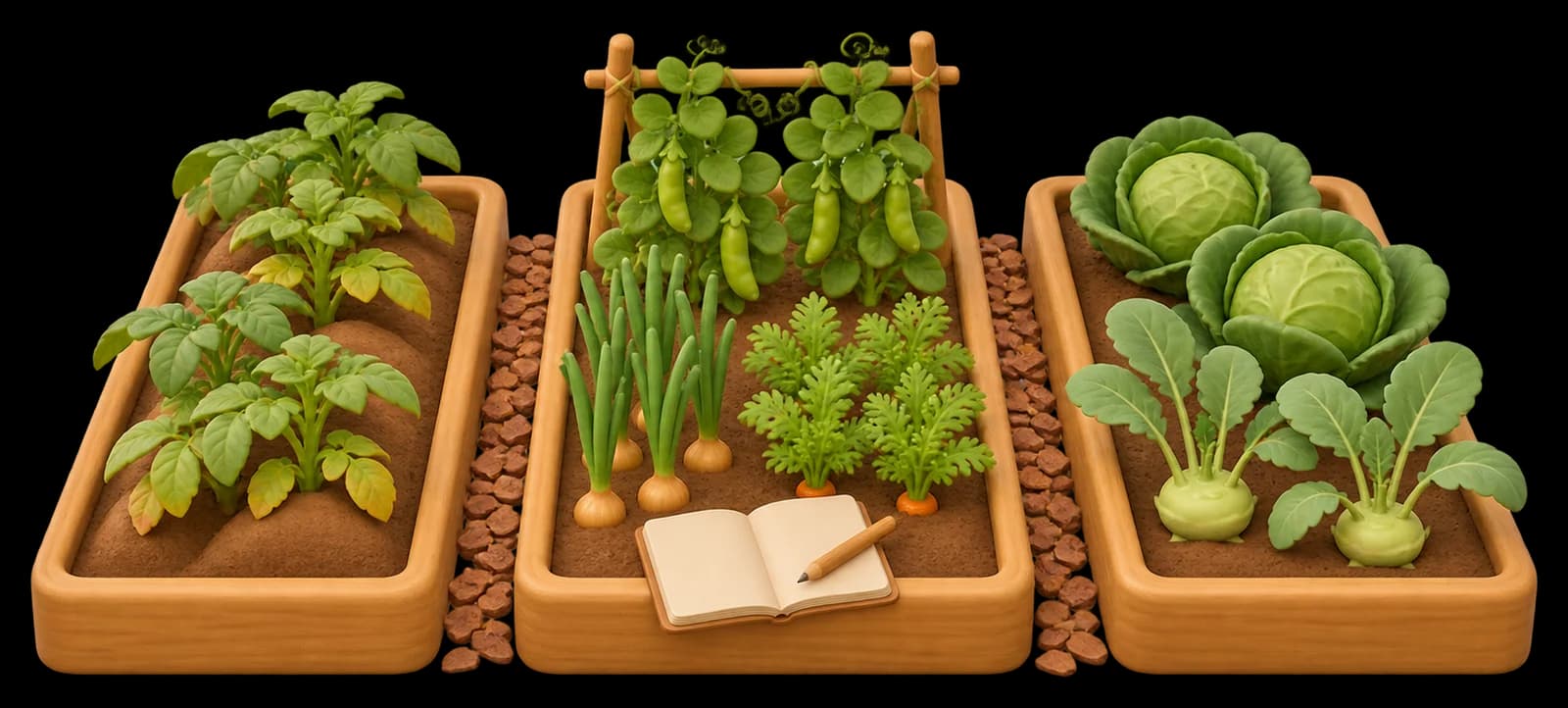
The plan works best with three or four beds, and needs some care with only one. Below are the RHS crop groups, the three- and four-year plans as charts, what fits in each 1.2 × 2.4 m bed at Sowstory's spacing, and what rotation can and cannot do.
Why rotate crops?
The RHS gives three reasons:
- Pests and diseases. Many soil pests and diseases attack one plant family. While the host is absent, their numbers fall. The RHS names clubroot (in brassicas) and onion white rot as examples. Gardeners' World adds that growing potatoes in the same soil year after year lets potato eelworm build up.
- Nutrients. Different crops take different amounts from the soil, so moving them spreads the demand and makes particular deficiencies less likely.
- Weeds. Crops with dense, spreading leaves such as potatoes help smother weeds before the next crop goes in.
Gardeners' World adds two practical points. Pea and bean roots carry small nodules that add nitrogen to the soil, so they are best grown the year before hungry brassicas. And root crops should not go on freshly manured ground, which is one reason they follow the brassicas.
Crop rotation chart: the five RHS groups
| Group | Crops (RHS) | Planned by Sowstory |
|---|---|---|
| Legumes | peas, broad beans, French beans, runner beans | dwarf peas, mangetout, dwarf broad beans, dwarf and climbing French beans, runner beans |
| Brassicas | Brussels sprouts, cabbage, cauliflower, kale, kohl rabi, oriental greens, radish, swede, turnip | sprouts, compact cabbage, cauliflower, calabrese, sprouting broccoli, kale, kohlrabi, pak choi, radish, baby turnip |
| Onions | onion, garlic, shallot, leek | onion sets, spring onions, garlic, leeks |
| Potato family | potato, tomato | first early, second early and maincrop potatoes, bush and cordon tomatoes |
| Roots | beetroot, carrot, celeriac, celery, Florence fennel, parsley, parsnip | beetroot, carrots, parsnips, celery, parsley |
The RHS counts swedes and turnips as brassicas, not roots; both belong to the cabbage family. Sources do not all group crops the same way: Gardeners' World puts peppers and aubergines in the potato family and treats radishes, peas and beans as crops that can go anywhere, while the RHS lists radish with the brassicas. If in doubt, follow one source consistently.
Crops that can go anywhere
The RHS lets some crops go wherever there is room, as long as they do not stay in the same spot too often:
- courgettes, cucumbers, marrows, squashes and pumpkins
- lettuce, endive, chicory and other salads
- sweetcorn
- peppers and aubergines, which the RHS says have fewer problems
Perennials such as rhubarb and asparagus stay out of the rotation in their own area. Gardeners' World also suggests tucking quick crops such as lettuce, rocket and radishes between the main crops.
A 3 bed crop rotation plan
The RHS method is to divide the plot into equal sections and move each section on one step a year: legumes, onions and roots follow potatoes; brassicas follow legumes, onions and roots; and potatoes follow brassicas. Three raised beds make the three sections.
3 year crop rotation chart
| Bed | Year 1 | Year 2 | Year 3 |
|---|---|---|---|
| Bed 1 | Potatoes | Legumes, onions and roots | Brassicas |
| Bed 2 | Legumes, onions and roots | Brassicas | Potatoes |
| Bed 3 | Brassicas | Potatoes | Legumes, onions and roots |
In year 4 you are back to year 1. Tomatoes, as members of the potato family, go with the potatoes.
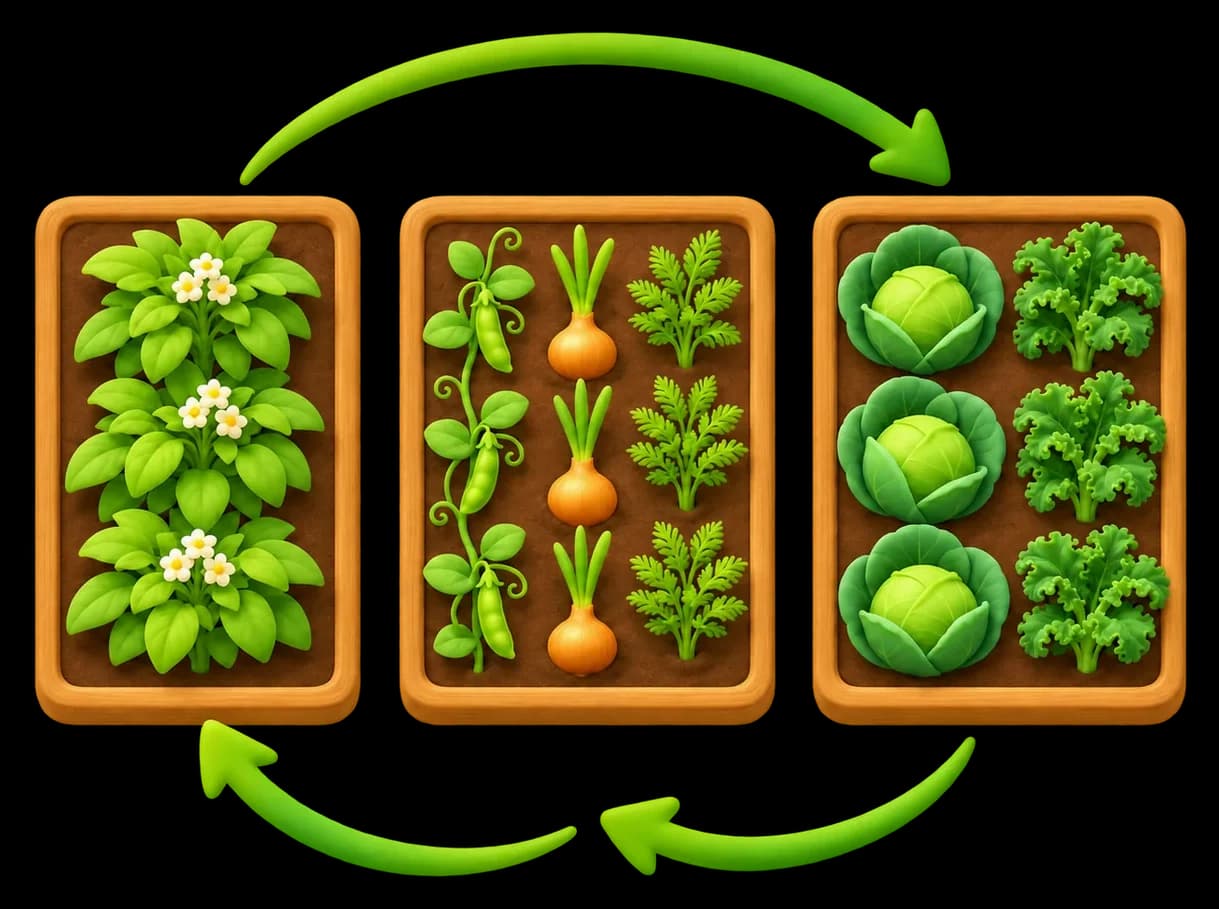
What fits in each 1.2 × 2.4 m bed
Here is one way to fill three 1.2 × 2.4 m beds in year 1, with rows along the 2.4 m length. The strip widths are Sowstory's row allowances and must add up to no more than the 120 cm inside width; plants per row are the 240 cm row length divided by the in-row spacing, rounded down.
| Bed | Rows | Strips | Plants per row |
|---|---|---|---|
| Potatoes | first early potatoes, loose-leaf lettuce | 90 + 25 = 115 cm | 240 ÷ 30 = 8 tubers; 240 ÷ 15 = 16 lettuces |
| Legumes, onions and roots | dwarf peas, onion sets, beetroot | 60 + 25 + 30 = 115 cm | 240 ÷ 7.5 = 32 pea seeds; 240 ÷ 10 = 24 sets; 240 ÷ 10 = 24 beetroot |
| Brassicas | kohlrabi, pak choi, baby turnips, radishes | 30 + 40 + 30 + 15 = 115 cm | 16; 9; 24; 96 |
Potatoes take the most room: Sowstory allows a 90 cm strip for one row so the soil can be drawn up into a ridge. Lettuce can go anywhere in the rotation, so it fills the gap. Larger brassicas fit the brassica bed too, but they are hungry for space: Sowstory gives a compact cabbage or calabrese a 45 × 45 cm square and Brussels sprouts a 60 × 60 cm square, and plans no more than four cabbages or three sprouts in one bed. The vegetable spacing chart has the gaps for every crop, and our raised bed layout ideas show more mixed plans.
A 4 year crop rotation chart
The RHS suggests four sections where potatoes and brassicas matter less to you and you want more legumes and onion-family crops. Legumes get their own section, and the order becomes legumes, then brassicas, then potatoes, then onions and roots.
| Bed | Year 1 | Year 2 | Year 3 | Year 4 |
|---|---|---|---|---|
| Bed 1 | Legumes | Brassicas | Potatoes | Onions and roots |
| Bed 2 | Brassicas | Potatoes | Onions and roots | Legumes |
| Bed 3 | Potatoes | Onions and roots | Legumes | Brassicas |
| Bed 4 | Onions and roots | Legumes | Brassicas | Potatoes |
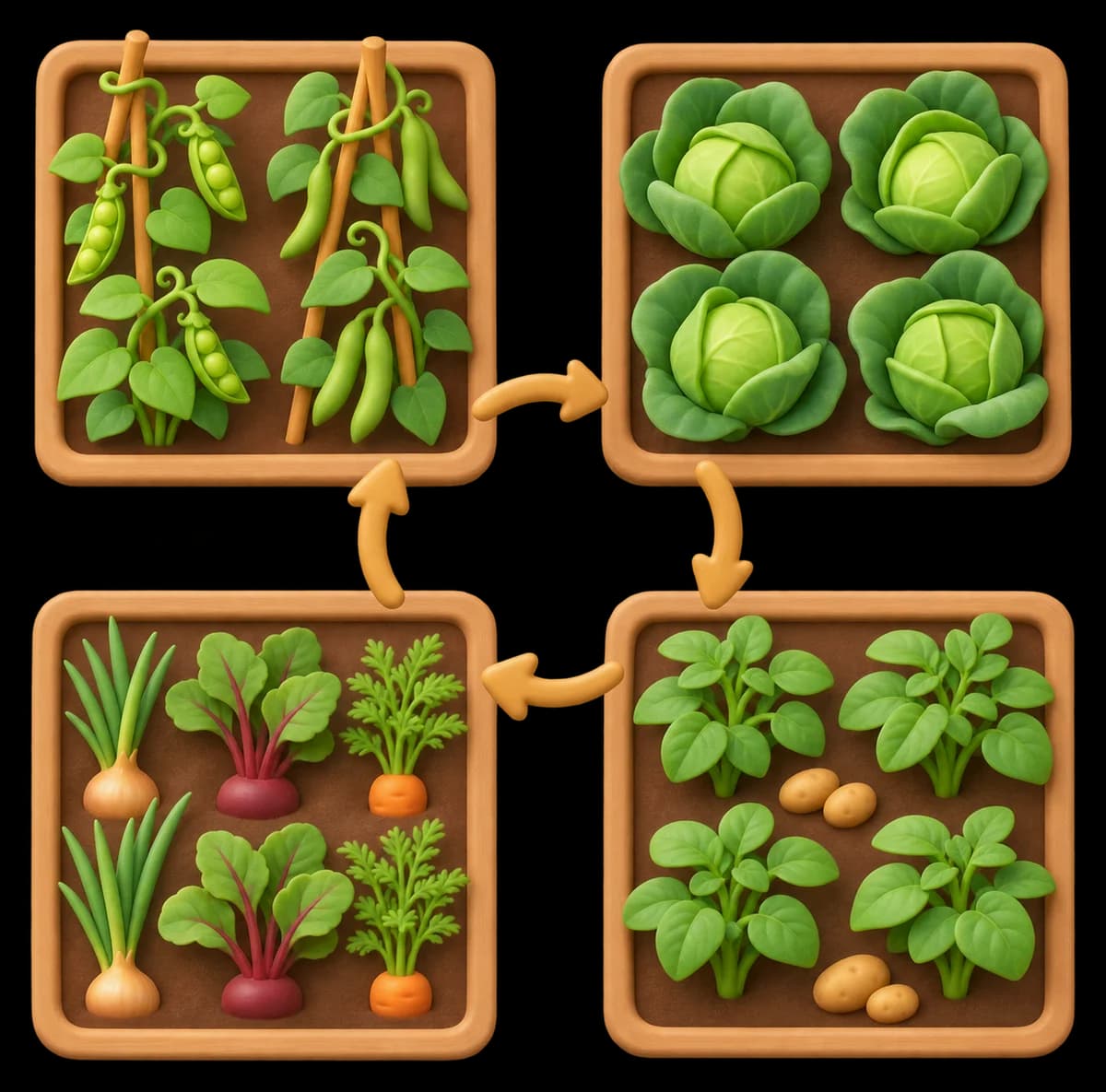
Four 1.2 × 1.2 m beds in a square with cross paths suit this well; see the four-square plan in our vegetable garden layout plans. Gardeners' World says four years is better than three if you have the space.
Crop rotation with only one raised bed
The RHS says rotation suits all but very small vegetable gardens, but neither the RHS nor Gardeners' World gives advice written for a single raised bed. The RHS method itself is simply to split the growing area into equal sections, so you can apply it within one bed:
- Split the bed into sections. A 2.4 m bed divides into three sections of 240 ÷ 3 = 80 cm, with rows running across the 1.2 m width, and the groups move on one section a year as in the chart above.
- Watch the potato section. One row of potatoes needs a 90 cm strip in Sowstory's plans, which is more than an 80 cm section. Gardeners' World notes that pots and growing bags can be emptied, cleaned and refilled, so they need no rotation; potatoes in a large bag beside the bed keep them out of it altogether.
- Keep expectations modest. The sections share the same soil and sit side by side, so treat this as good practice rather than real protection.
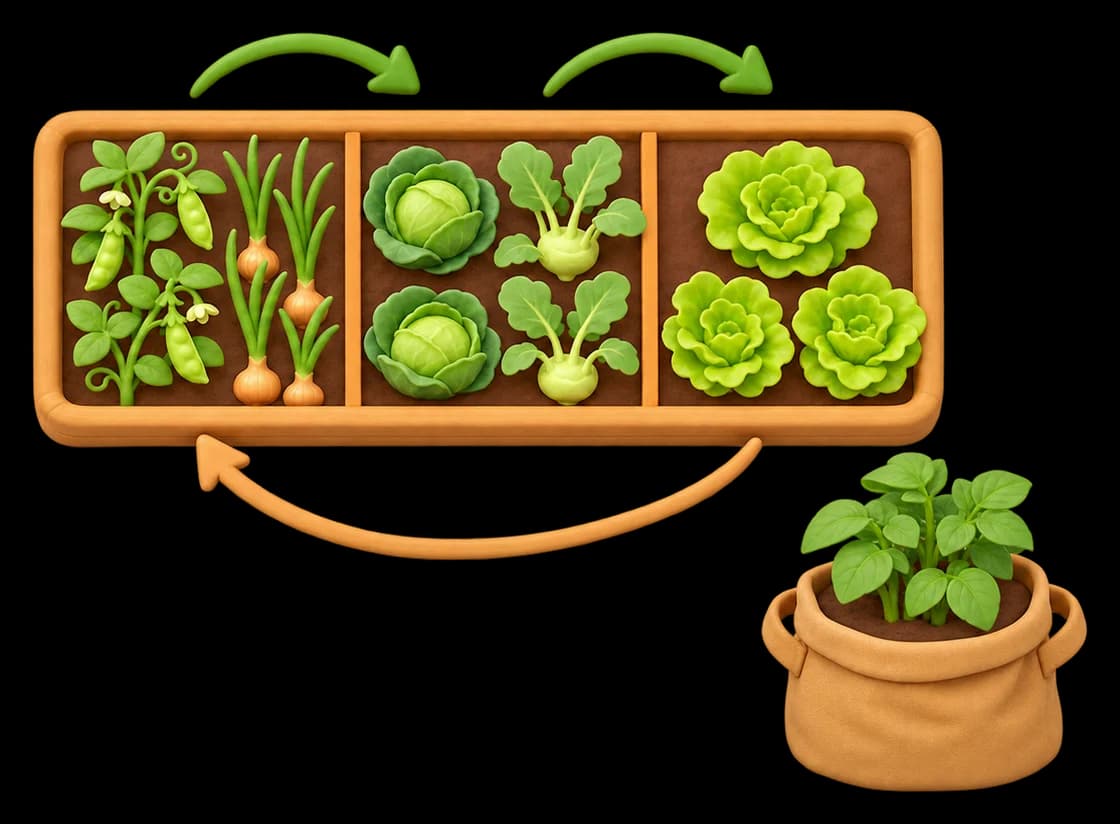
If you only have one small bed, it may be simpler to grow mainly crops that can go anywhere, such as salads and a courgette, and to avoid planting the same family in the same spot two years running.
What crop rotation cannot do
Rotation helps reduce soil-borne problems; it does not clear them once they are established.
- Clubroot. The RHS says its resting spores can survive in soil for up to 20 years. Better drainage, such as a raised bed, and liming acid soil reduce it but do not get rid of it. Buy plants from clubroot-free sources and do not move infected soil. Our guide on how to grow broccoli covers it in more detail.
- Onion white rot. Its resting bodies survive at least 15 years, so the RHS calls rotation impractical once the disease is present. It spreads on soil, tools and boots. See how to grow onions and how to grow garlic.
- Potato blight. The RHS advises rotating potatoes for at least four years, but says most garden infection arrives as wind-blown spores, so rotation does not stop it. Our guide on how to grow potatoes explains how to spot and manage it.
Companion planting is sometimes suggested as a partner to rotation, but its evidence is mixed; our companion planting guide sets out what is known.
When to plan your rotation
The RHS suggests planning the rotation before the growing season, ideally when you order seed, and marking out the sections on the ground. Its January jobs list includes planning the rotation and buying seed potatoes. Write down what grew in each bed every year: Gardeners' World names keeping these notes as the main chore of rotating, and without them it is easy to lose track by year three.
Is there a crop rotation planner in Sowstory?
No. Sowstory plans one season at a time. You enter a bed's inside size, how much sun it gets, which edge faces north and the crops you like or want to avoid, and it lays out that bed to scale with a month-by-month timing plan for England. It does not plan crop rotation across years, and it will not move crop groups from bed to bed for you. Its sowing months are England-wide and are not adjusted for your postcode.
What it can do is lay out this season's bed once you have chosen its group from the charts above. The optional private journal for each bed, with notes and up to five pictures per entry, is one place to record what grew where.
If you have picked this year's group for a bed and would rather not work out the rows by hand, Sowstory will lay the bed out to scale and tell you how many plants fit. It works in your web browser now, and your first bed is free.