
To grow leeks in England, plant young leeks about the thickness of a pencil into deep dibber holes in May or June, 15–23 cm apart, and water them in without filling the holes. Earth them up as they grow, and winter varieties such as 'Musselburgh' will be ready to lift from November to February.
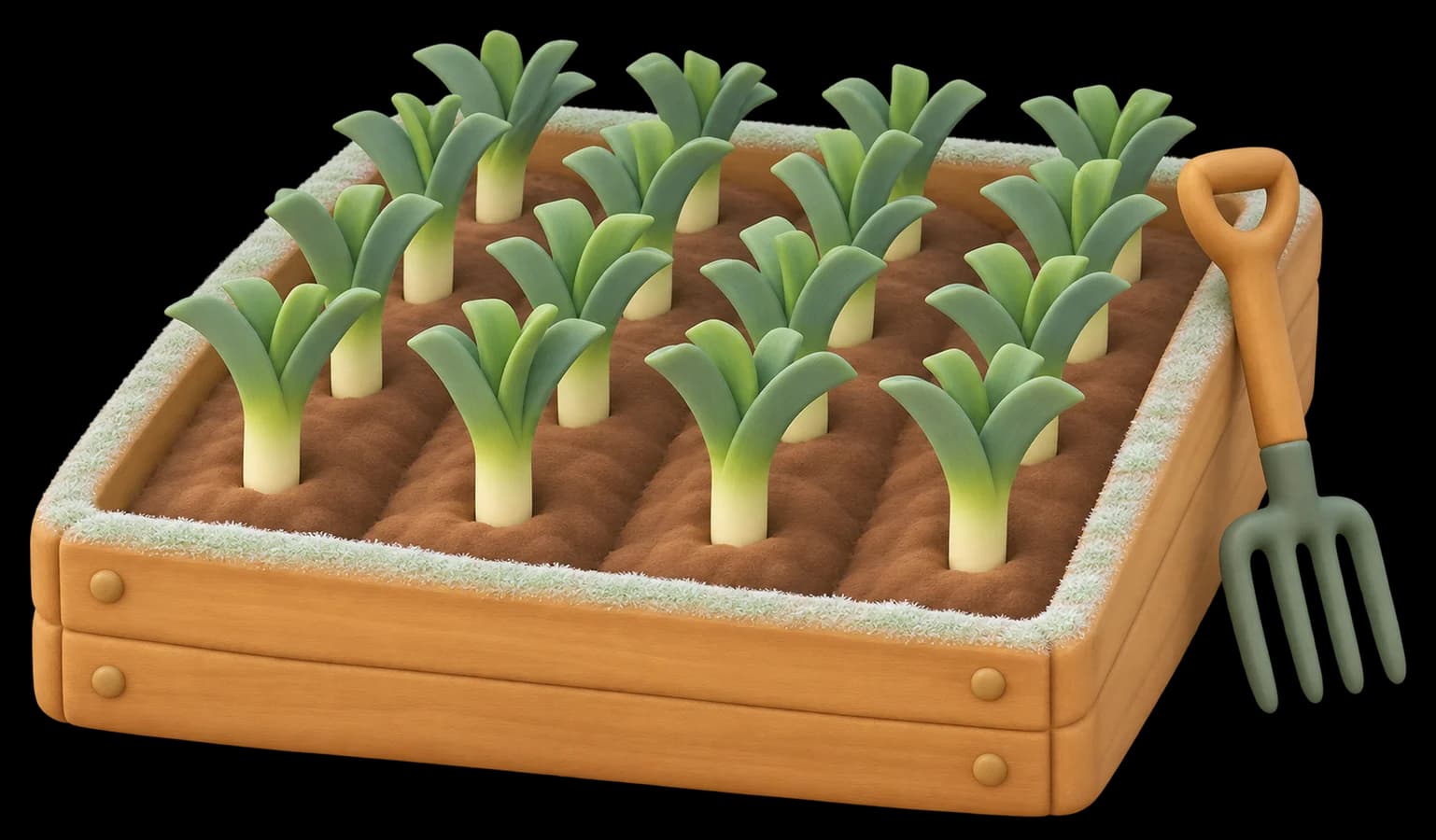
Leeks are hardy and easy to look after, but they hold their space in a raised bed for most of a year. This guide covers sowing or buying plants, planting, how many fit a bed, blanching, harvest and the pests that now trouble leeks in much of England.
Leek quick facts
| Fact | Detail |
|---|---|
| Sow seed | March to May, outside the bed (Sowstory); RHS main months March and April |
| Plant out | May to June, at about 20 cm tall and pencil-thick |
| Planting hole | About 15 cm deep (RHS); 20 cm (Gardeners' World) |
| Leek spacing | Sowstory 23 cm in the row (RHS: 15–20 cm) |
| Between rows | 30 cm (Sowstory and RHS) |
| Sun | Full sun, at least six hours of direct sun |
| Harvest | November to February for winter leeks (Sowstory) |
| Time in the bed | Sowstory reserves about 40 weeks |
| In a 1.2 × 2.4 m bed | About 40 leeks in four rows |
How to grow leeks: seed or young plants
Most leeks are sown in one place and moved to their final spot later, when they have grown into slim, upright seedlings. You can raise your own from seed or buy young plants; Gardeners' World notes that leek seedlings are sold by nurseries and by mail order.
Sowstory plans winter leeks, modelled on 'Musselburgh', as transplants bought in or raised elsewhere. Its plan takes up bed space only from planting, so the seedling months happen outside the bed. The seed-sowing section below is general guidance from the RHS and Gardeners' World.
When to sow leeks
The RHS names March and April as the main sowing months, with later varieties and fast baby leeks sown in May and June. Sowstory's knowledge base gives March to May for raising winter leeks in a separate nursery spot. Leeks feature in our guide to what to sow in April.
- Outdoors in a seedbed: make a drill about 1.5 cm deep, water along the bottom and sow thinly, with rows about 30 cm apart. The RHS suggests fleece or cloches over early sowings in a cold snap, because low temperatures can make leeks bolt later.
- Indoors: from late winter, sow thinly 1.5 cm deep in small pots or modules of peat-free seed compost, kept above 10°C in good light. Gardeners' World gives 10–15°C, with seedlings appearing in 14–21 days, and calls sowing in pots the more reliable route. See what to sow in February for other crops to start under cover.
The RHS says seedbed leeks are usually ready to move about two months after sowing, and module-raised ones after about eight weeks.
When to plant leeks in the UK
Plant leeks out when they are about 20 cm tall and roughly pencil-thick. Sowstory's planting window for England is May to June, which is why leeks appear in our guides to what to sow in May and what to sow in June. Gardeners' World describes transplanting in summer, and the RHS July jobs list still includes planting out leeks, so a late batch is not wasted.
Harden off plants raised indoors before they go out. Timing shifts with where you live: the south and coasts are usually earlier, and the north, inland gardens and high ground later.
How to plant leeks
Prepare the bed
Leeks want a sunny spot with free-draining, fertile soil. The RHS suggests weeding thoroughly and working in about two buckets of garden compost or well-rotted manure per square metre before planting, and avoiding ground that grew leeks or other onion-family crops in the last few years.
Dibber holes and puddling in
- Make a hole with a large dibber or the handle of a trowel. The RHS says about 15 cm deep and 5 cm across; Gardeners' World uses 20 cm. The RHS says deep planting helps form the long white stem.
- Trim the roots to about 2.5 cm if you like (an RHS suggestion that Gardeners' World does not mention).
- Drop one leek into each hole.
- Fill the hole with water and leave it. The water settles soil around the roots; do not push soil back in by hand.
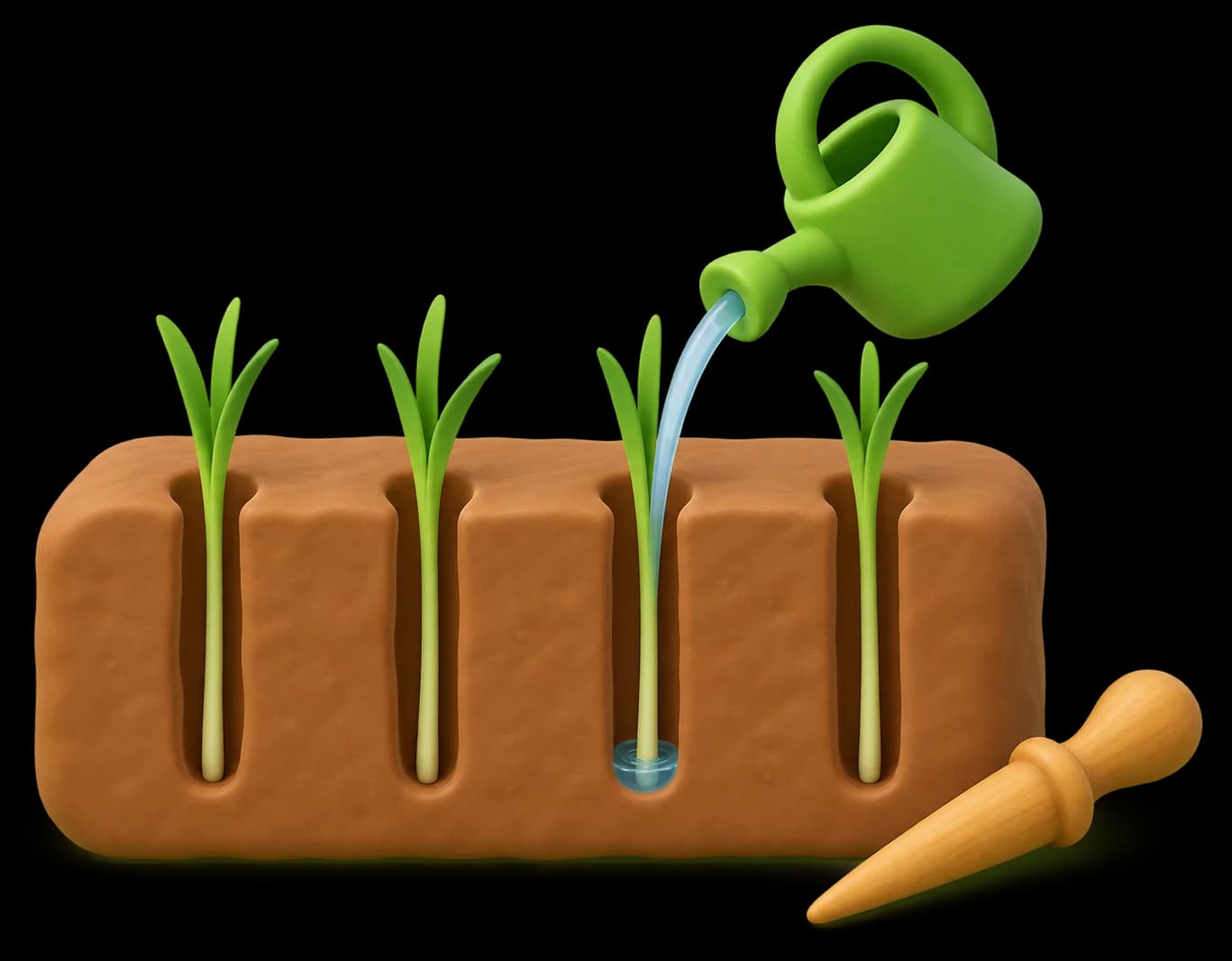
Gardeners' World calls this "puddling in". Gardeners' World also mentions planting leeks in small clumps as an alternative.
Leek spacing
Sources differ. The RHS gives 15–20 cm between plants, depending on variety, and 10 cm for baby leeks, with rows 30 cm apart. A seed supplier gives 23 cm for 'Musselburgh'. Sowstory allows 23 cm in the row and 30 cm between rows, the more generous figure, so each leek has room to thicken and air can move between them.
Growing leeks in raised beds: how many fit
In a 1.2 × 2.4 m bed (about 4 × 8 ft) with rows along the length, Sowstory's spacing works out as:
- 1.2 m ÷ 30 cm between rows = four rows.
- 2.4 m ÷ 23 cm in the row = 10 leeks per row (rounded down).
- Four rows × 10 = about 40 leeks if the whole bed were leeks.
Four rows is also the most Sowstory plans for leeks in one bed. At the RHS's closer 15 cm you could squeeze in more, with thinner stems.
The bigger question is time. Sowstory reserves leeks' space for about 40 weeks, from planting in early summer until the last leeks are lifted in late winter. That leaves no room for a second crop in that row the same season, so it is worth deciding early which part of the bed they take. Leeks are medium height; our raised bed layout guide explains where taller and shorter crops go, and the plant spacing chart has every crop's figures.
Sowstory sets no minimum bed depth for leeks, but a 15–20 cm planting hole needs at least that much loose soil underneath it.
If you want to see how a long-stay leek row fits around your summer crops, Sowstory lays out your bed to scale, tells you how many leeks fit and gives a month-by-month timing plan for England. It works in your web browser now, and your first bed plan is free.
Caring for leeks
- Watering. Water young plants until they have settled in, then in dry spells. The RHS advises keeping water off the leaves, as wet foliage encourages leek rust.
- Weeding. Keep the rows weed-free so the young leeks are not crowded: hoe between rows and weed by hand close to the stems.
- Mulching. A layer of garden compost around the plants holds moisture and keeps weeds down.
- Flower stalks. If a leek bolts, the RHS says to remove the flower stalk as soon as it appears, because flowering makes the centre tough. Tightly closed flower buds are good lightly cooked.
- Winter. Established leeks are hardy and need no frost protection.
Earthing up and blanching
The white part of a leek is stem kept out of the light. Planting deep starts it; earthing up adds to it. Draw soil up around the stems several times as they grow, keeping it out of the leaves where you can. The RHS adds that earthing up helps leeks stand firm in winter storms.
Harvesting leeks
You can harvest leeks at any size. The RHS says full-sized leeks take about six months from sowing, and you can start with small ones from late summer, taking every other plant so the rest have room to fatten. Sowstory's harvest window for 'Musselburgh'-type winter leeks is November to February, and they may stand longer.
Lift leeks gently with a fork rather than pulling them, and take only what you need. Hardy winter varieties can stay in the ground through the coldest weather, and late varieties into spring. Once lifted, Gardeners' World says leeks keep for a couple of weeks in the fridge or a cool larder.
Common leek problems
- Leek moth. Mainly found in southern England, according to the RHS, but spreading north. Its caterpillars eat inside the leaves and stems, leaving white patches and tunnels, and secondary rots can follow. Larvae feed in May–June and again in August–October. The RHS suggests covering leeks with insect-proof mesh for the whole growing season and squashing the white, net-like cocoons on the leaves.
- Allium leaf miner. First found in Britain in 2002 and now widespread in England, says the RHS. Look for lines of white dots on the leaves; maggots tunnel into stems, and plants often rot in autumn. Adults lay eggs in March–April and September–November, so cover leeks with fine insect-proof mesh during those periods.
- Leek rust. Bright orange spots on the leaves from midsummer to late autumn. The RHS links it to crowding and to soil rich in nitrogen but low in potassium, and no fungicides are approved for home gardeners. Choose rust-resistant varieties if you have had it before; Gardeners' World describes 'Musselburgh' as rust-resistant.
- White rot. A soil fungus shared with onions and garlic: leaves yellow and wilt, with white fluffy growth at the base. The RHS says the tiny black specks it leaves survive in soil for at least 15 years, and gardeners have no chemical control.
- Onion fly. Maggots damage roots and can kill seedlings (RHS).
- Bolting. Low spring temperatures can trigger it, so the RHS suggests protecting early sowings.
For allium leaf miner and leek moth, the RHS also recommends rotation, because both can carry over in the soil or under the same mesh from one year to the next.
Leeks, rotation and companions
The RHS places leeks in the onion group with onions, garlic and shallots, which moves round the beds together in a rotation. Sowstory plans one season at a time and does not plan rotation across years; our crop rotation guide shows where the onion group goes each year. For the other members of the group, see how to grow onions and how to grow garlic.
Leeks are often paired with carrots. Gardeners' World says leek scent deters carrot fly and carrot scent deters leek moth, but gives no data, and the RHS carrot fly page does not list onion-family companions among its controls. Our companion planting guide covers the evidence.
Sources
- RHS: How to grow leeks
- Gardeners' World: How to grow leeks
- Gardeners' World: What to plant in February
- RHS: July jobs
- RHS: Leek moth
- RHS: Allium leaf miner
- RHS: Leek rust
- RHS: Onion white rot
- RHS: Crop rotation
- RHS: Carrot fly
- Gardeners' World: Companion plants to grow
- Sowstory knowledge base, release v1.4