
To grow broad beans in England, sow the seeds direct into a sunny, sheltered bed in March or April, about 5 cm deep and 23 cm apart in rows 45 cm apart. Dwarf varieties need little support in a raised bed and give pods to pick from June to August.
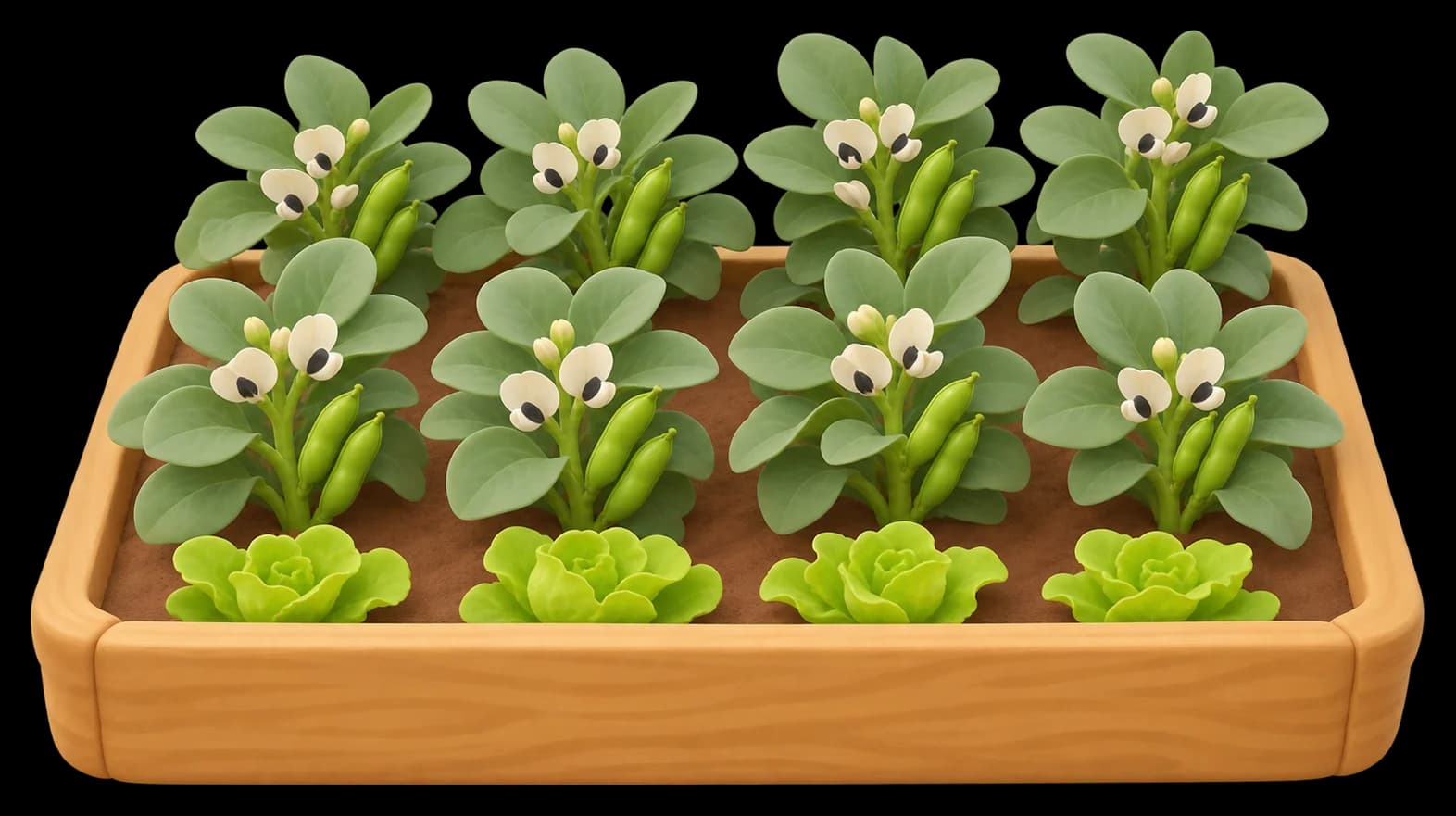
Hardy varieties can even be sown in autumn and stand outside through winter, but spring sowing is simpler and is what Sowstory plans. This guide covers spring and autumn sowing, how many plants fit a raised bed, support, pinching out, harvest and the problems to watch for.
Broad bean quick facts
| Fact | Detail |
|---|---|
| Sow in the bed | March to April (Sowstory, dwarf beans sown direct) |
| Sowing depth | 5–7.5 cm (RHS); 5 cm (Gardeners' World) |
| Broad bean spacing | Sowstory allows 23 cm in the row (RHS: 15–23 cm) |
| Between rows | 45 cm for single rows (Sowstory and RHS) |
| Sun | Full sun, at least six hours of direct sun |
| Height | Dwarf varieties about 50 cm (RHS) |
| Harvest | June to August (Sowstory); late spring to late summer (RHS) |
| Time in the bed | Sowstory reserves about 22 weeks |
| In a 1.2 × 2.4 m bed | About 20 plants in two rows |
When to sow broad beans
Sowstory plans one route: a dwarf broad bean, modelled on 'The Sutton', sown straight into the bed in March or April. Broad beans feature in our guides to what to sow in March and what to sow in April for that reason. The RHS gives the same spring months and adds early May.
The soil, not the calendar, decides the exact week. Cold, wet soil can rot the seed, so in the north, inland or on high ground it often pays to wait until later in March or into April. The south and coasts usually warm up earlier.
Sowing broad beans indoors first
If your soil is heavy or slow to dry, or mice take your seed, start the beans in pots. The RHS sows single seeds about 5 cm deep in small pots or modules from February, scar facing down, and keeps them somewhere bright. Gardeners' World says they come up in about three weeks in a cold frame or unheated greenhouse and are ready to plant out about six weeks after sowing, once the roots fill the pot. Harden them off and plant them in early to mid spring at the same spacing as direct-sown beans, then water them in. See what to sow in February for what else can start under cover that month.
When to plant broad beans in the UK: autumn sowing
Broad beans can also go in during autumn for an earlier crop. The RHS suggests October or November (or February) in milder regions or on sheltered, well-drained sites, using a hardy variety; it recommends 'Aquadulce Claudia' for autumn sowing and overwintering. Gardeners' World says autumn sowings give a crop from May the following year. The RHS also suggests fleece or cloches over early sowings in cold spells, and pots in an unheated greenhouse in cold areas.
There are trade-offs. Gardeners' World calls spring sowing generally more reliable, especially on heavy clay where seed may rot before it germinates, and notes that chocolate spot is most common on autumn-sown crops.
Sowstory does not plan autumn-sown broad beans yet: its broad bean profile is spring-sown only, with no protected autumn or winter route. If you sow in autumn, treat it as your own addition alongside our guides to what to sow in October and what to sow in November.
How to grow broad beans: sowing direct
Prepare the bed
Choose a sunny, sheltered spot with rich, free-draining soil. The RHS suggests weeding thoroughly and digging in at least two bucketfuls of well-rotted manure or garden compost per square metre a few weeks before sowing. In a no-dig raised bed, a compost mulch at least 5 cm thick laid between November and February does the same job.
Depth and spacing
Push each bean in 5–7.5 cm deep (the RHS figure; Gardeners' World says 5 cm). Sources differ on spacing:
- The RHS gives 15–23 cm between plants, with single rows 45 cm apart. Its alternative is double rows 23 cm apart, with 60 cm between each pair.
- Gardeners' World gives about 20 cm between plants and 60 cm between rows.
- A seed supplier gives 10–15 cm in the row for 'The Sutton'.
Sowstory plans single rows 45 cm apart with 23 cm between plants: the more generous in-row figure, which leaves air between plants and room for your hands at picking time. It does not use the double-row method. Sow a few spare beans at the row ends so you can fill any gaps.
Gardeners' World suggests netting newly sown rows, as birds and squirrels may dig up the seed.
Growing broad beans in raised beds: how many fit
In a 1.2 × 2.4 m bed (about 4 × 8 ft) with rows running along the length:
- 1.2 m ÷ 45 cm between rows = two rows across the bed.
- 2.4 m ÷ 23 cm in the row = 10 plants per row (rounded down).
- Two rows × 10 = about 20 plants if the whole bed were broad beans.

That is four plants per metre of row. Sowstory allows up to four rows of broad beans in one bed, which only a wider bed would hold. Most people give them a single row and share the rest of the bed.
Dwarf broad beans, at about 50 cm, are not one of the tall crops that Sowstory puts on the north edge, but they will cast some shade over low salads behind them. Our raised bed layout guide explains how to arrange crops by height, and the plant spacing chart lists broad beans alongside every other crop. Sowstory sets no minimum bed depth for them.
Time matters as much as space. Sowstory reserves a broad bean row for about 22 weeks, so a March sowing holds its ground until about August, and an April sowing into September.
If you would rather not work out how the bean rows fit around everything else, Sowstory will lay out your bed to scale, tell you how many plants fit and give a month-by-month plan for England. It works in your web browser now, and your first bed plan is free.
Caring for broad beans
- Watering. Beans in the ground rarely need watering unless the soil is light and sandy. The RHS suggests a thorough soak when the plants start to flower and another two weeks later; Gardeners' World says to water regularly once flowers appear.
- Mulching and weeding. The RHS suggests a mulch around the plants once they are in, to hold moisture and deter weeds. Hoe between rows while the plants are young.
- Feeding. Most soils supply enough. The RHS suggests a high-potassium liquid feed, such as tomato feed, every fortnight from first flowering only for dwarf beans in containers.
Do broad beans need support?
Dwarf varieties usually hold each other up, and the RHS suggests twiggy sticks if they lean. Sowstory plans its dwarf beans without support. Taller varieties need more: the RHS puts a sturdy stake at each corner of the row and every 1.2 m along it, with string run round at 30 cm intervals. Gardeners' World puts strong supports at the row ends and advises putting supports in while plants are still small.
Pinching out
Once the lowest flowers have formed small pods, the RHS says to pinch out the shoot tips. Gardeners' World suggests doing it as soon as the first flowers appear. It sends the plant's energy into the pods and removes the soft tips where blackfly gather. The tips are edible, steamed or stir-fried.

Harvesting broad beans
Sowstory expects spring-sown dwarf beans to crop from June to August, depending on when you sowed and the weather. The RHS gives late spring to late summer, and Gardeners' World May to August, with autumn sowings coming first.
- For shelling, pick pods when they are full but still fairly small; small beans are sweeter. The RHS says the scar on each bean should be white or green; a black scar means the bean is getting tough.
- For whole pods, pick them young: about 5 cm long (RHS) or 6 cm (Gardeners' World).
- Pick often, using scissors or secateurs, and check the lowest pods every few days, as they ripen quickly.
Gardeners' World suggests blanching surplus beans for three minutes, then cooling them in cold water before freezing. When the plants have finished, cut them off at the base and leave the roots in the ground: broad beans are legumes, and their root nodules fix nitrogen.
Common broad bean problems
The RHS describes broad beans as generally robust. The problems it and Gardeners' World name are:
- Blackfly (black bean aphid). Dense colonies on the shoot tips in spring and summer, which can stunt growth. Pinching out the tips is the main defence.
- Chocolate spot. A common fungal disease that leaves chocolate-brown spots on any part of the plant (RHS). Gardeners' World says it is worst in damp weather, on crowded plants and on autumn sowings, and gardeners have no chemical control. Give plants room, keep weeds down, bin rather than compost infected growth, and do not save seed from affected plants.
- Rust. Dark brown, powdery spots on the leaves (RHS).
- Mice and voles. They dig up and eat seed sown outside. Starting beans in pots avoids this.
- Slugs and snails. They can damage young shoots.
- Pea and bean weevil. Adults cut notches in leaf edges. Gardeners' World says plants usually survive and you can pick off any beetles you see.
- Broad bean seed beetle. Mainly noticed by people who save their own seed (RHS).
Broad beans, rotation and companions
The RHS puts broad beans in the legume group with peas, French beans and runner beans, and its rotation sequence has brassicas such as cabbages following legumes. Sowstory plans one season at a time and does not plan rotation across years; our crop rotation guide has three- and four-year plans you can follow by hand. If you want peas in the same bed, how to grow peas covers their spacing and support.
Two companion ideas come up often. Gardeners' World suggests borage near broad beans to draw in pollinators and hoverflies, whose larvae eat blackfly, and says nasturtiums can lure blackfly off beans. It also lists onions or garlic next to beans as a pairing to avoid. None of these comes with trial data, so treat them as gardeners' experience; our companion planting guide sets out what the evidence does and does not support.