
To grow peppers outdoors in England, sow seed indoors in warmth in late March or April, then plant the young plants into the warmest, most sheltered spot in your raised bed in June, once nights stay above 12°C. Expect a smaller, later crop than from a greenhouse: the RHS says outdoor peppers start fruiting in August and finish in early autumn.
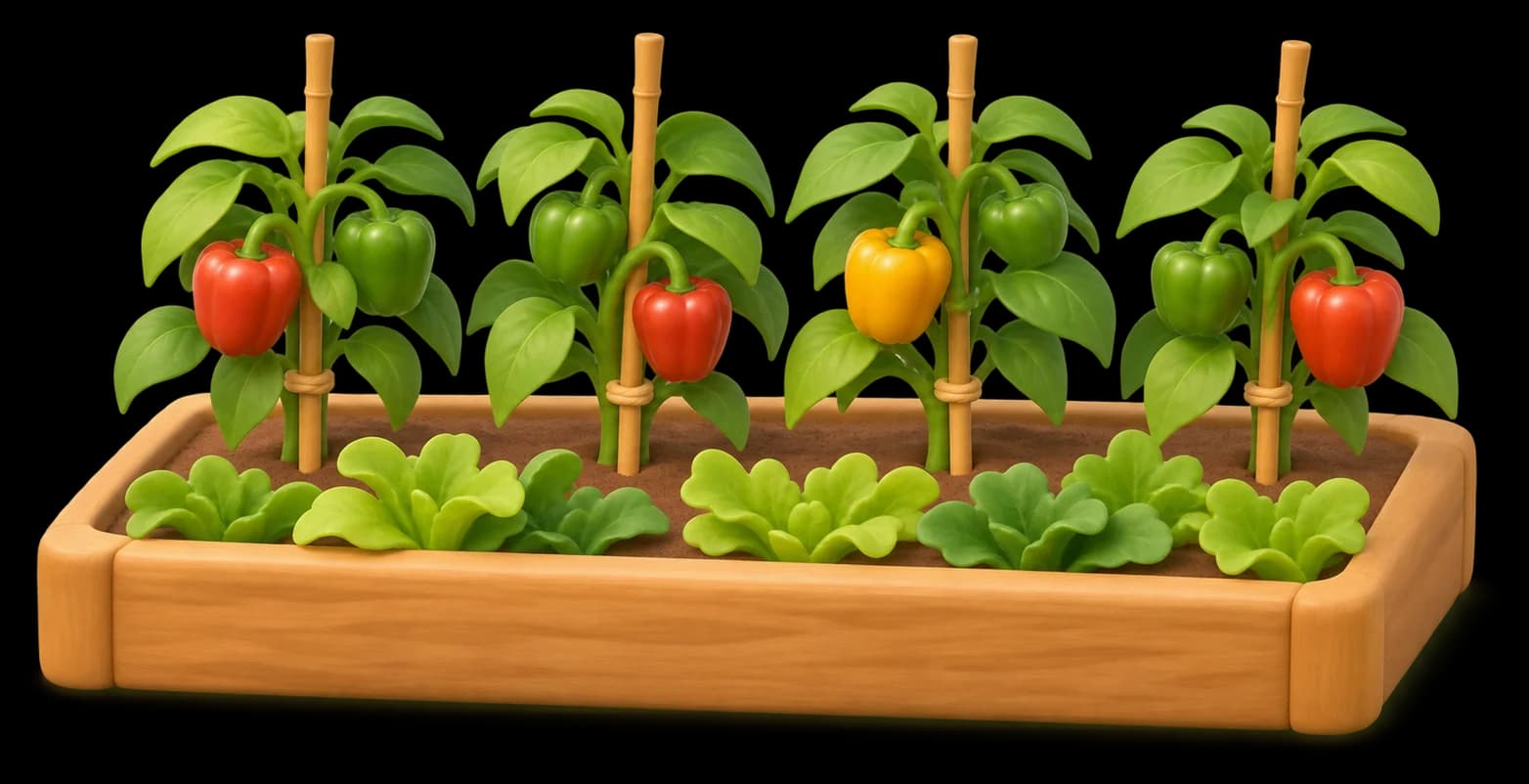
This guide covers sweet peppers (bell and long peppers) grown outside in a raised bed: when to sow and plant, how many fit, care, harvest and the problems to watch for. Chillies are grown in much the same way, with a short note on the differences below.
Pepper quick facts
| Fact | Outdoor sweet pepper |
|---|---|
| Sow indoors | Late March to April (RHS: late March to early April for outdoor crops) |
| Germination | 18–21°C, so a heated propagator or warm windowsill (RHS) |
| Plant into the bed | June in Sowstory; RHS late May or June once nights stay above 12°C |
| Spacing | Sowstory 45 × 45 cm; RHS 38–45 cm, about 30 cm for compact types |
| Support | One sturdy cane per plant |
| Sun | At least six hours of direct sun, in a sheltered spot |
| Harvest | August to early autumn outdoors (RHS) |
| Bed space reserved | About 17 weeks from planting out |
| In a 1.2 × 2.4 m bed | Up to 4 plants in Sowstory's plan |
Can you grow peppers outdoors in England?
Yes, but it is not a sure thing. The RHS recommends growing sweet peppers under cover for most of the UK and says outdoor crops succeed only in milder areas or hot summers. Gardeners' World agrees that outdoors works well only in the mildest regions. Both the RHS and the seed company Mr Fothergill's say outdoor plants crop later and give smaller harvests than greenhouse ones.
That is why Sowstory treats outdoor peppers as a low-confidence crop: it plans them only for a warm, sheltered spot, and it cannot see how sheltered your garden is. If you have a greenhouse or polytunnel, peppers will do better there. In a raised bed, choose the warmest, sunniest corner and an early, compact variety, and accept that a cool summer means fewer fruits.
When to sow peppers
Peppers need a long, warm season, so they start indoors. The RHS gives two timings:
- For greenhouse plants: sow from mid-February to early March.
- For outdoor plants: sow in late March or early April. Gardeners' World gives March to April for outdoor crops, and Sowstory's window is late March to April.
Seed needs 18–21°C to germinate, so use a heated propagator if you have one, or a warm windowsill. Once the seedlings are up, the RHS suggests keeping them at 16–18°C in good light and the compost evenly moist.
When each seedling has two true leaves, move it into its own 7.5–9 cm pot and keep it warm. Our guides to what to sow in February and what to sow in March list the other crops started under cover at the same time.
When to plant peppers outside in the UK
Peppers are tender, so they go out only once frost risk has passed. The RHS keeps them indoors until at least late May and plants outdoors in late May or June, once nights are reliably above 12°C. Growth is better still above 15°C. Sowstory plans outdoor peppers into the bed in June only, and the RHS June jobs list also puts peppers out only after all frost risk has passed.
How early that comes depends on where you live. The RHS gives typical first safe times for planting tender crops out:
- South-west tip and south coast: the first to second half of May.
- Southern England: the second half of May.
- Midlands, north-west England and Yorkshire: the end of May.
- North-east England: early June.
Sheltered, urban or coastal gardens can be one to two weeks earlier; exposed, rural or high gardens should wait one to three weeks longer, and frost pockets later still. For peppers, wait for both: no more frost and nights above 12°C. Sowstory's months are England-wide and not adjusted to your postcode, so watch your own forecast. Our guide to last frost dates explains how to judge it, and what to sow in June covers the other tender crops going out that month, while what to sow in May lists the indoor jobs before then.
Hardening off and planting
The RHS pepper guide suggests about two weeks of hardening off, getting plants used to outdoor conditions a little more each day. Its general hardening-off advice allows two to three weeks, and longer for plants raised in warmth. It does not make a pepper frost-hardy.
A couple of weeks before planting, the RHS suggests warming the soil under a cloche. Plant at the same depth the pepper was growing in its pot, then keep young plants under cloches, ideally until the end of June.
Growing peppers in raised beds
Where to put them
The RHS says shelter from cold and strong winds is essential for peppers and aubergines, and its pepper guide asks for the warmest, sunniest spot you have. Sowstory requires at least six hours of direct sun. In a raised bed, that usually means the south-facing side, ideally with a fence or wall behind to block the wind.
The RHS gives a height of about 60 cm for sweet peppers, so they are mid-height plants. Keep them in front of anything tall, such as staked tomatoes or bean rows on the north edge, so they are not shaded, and behind low crops. Our raised bed layout guide explains the north-edge rule.
Pepper spacing and how many fit
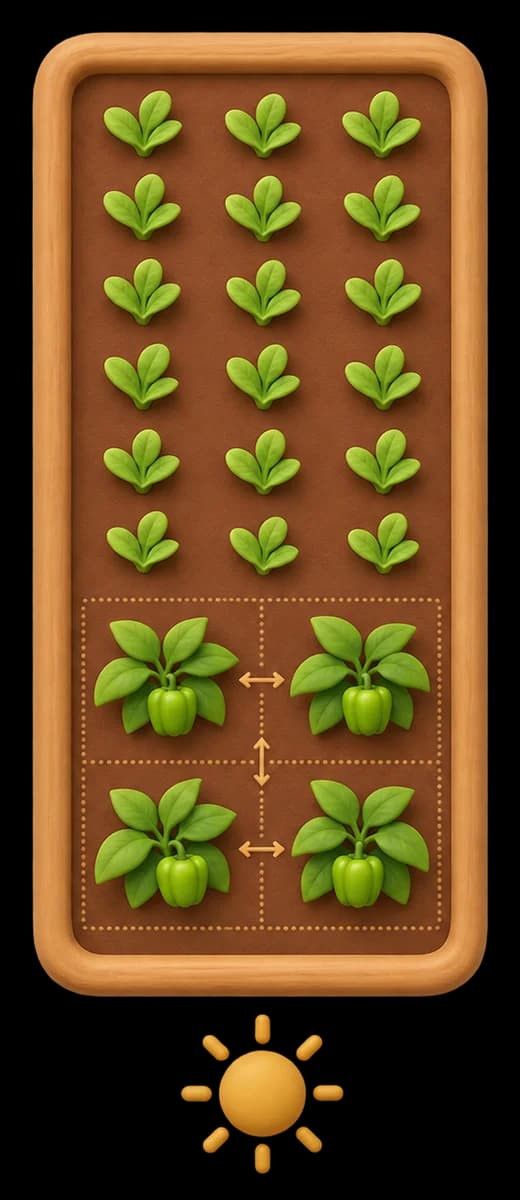
The RHS gives 38–45 cm between plants in the ground, or about 30 cm for compact varieties. Mr Fothergill's gives 40 cm for outdoor crops. Sowstory uses the top of the RHS range and allows a 45 × 45 cm square for each plant.
In a 1.2 × 2.4 m bed (about 4 × 8 ft), 45 cm squares fit two across the 1.2 m width (1.2 ÷ 0.45 = 2.7, so 2) and five along the 2.4 m length (2.4 ÷ 0.45 = 5.3, so 5). That is 10 plants if the whole bed were peppers. Sowstory caps outdoor peppers at four plants per bed, which take about 0.8 m² (4 × 0.45 × 0.45 m) and leave most of the bed for other crops. The plant spacing chart has the figures for everything you might grow alongside.
Sowstory sets no minimum bed depth for peppers. The RHS suggests a pot at least 30 cm wide for one plant, so a filled raised bed gives the roots plenty of room.
If you would rather not work out the spacing by hand, Sowstory will place up to four peppers in the sunniest part of your bed, tell you what fits around them and give a month-by-month plan for England. It works in your web browser now, and your first bed plan is free.
How to care for peppers
Support
Push a sturdy bamboo cane in beside each plant and tie the main stem to it as it grows. The RHS notes that pepper stems are brittle, so a heavily laden plant may need extra canes, with fruiting side-shoots tied in using soft twine.
Watering
Keep the soil steadily moist. The RHS warns that flower buds can drop if plants dry out, and Gardeners' World links both blossom end rot and grey mould to erratic watering. A thick mulch of organic matter around plants in the ground helps keep moisture in.
Feeding
Both sources suggest a high-potassium liquid feed, such as tomato feed, once flowering starts. Gardeners' World says weekly; the RHS says weekly for plants in containers, and that plants in rich soil may not need regular feeding, though feeding can increase the crop.
Pinching out: sources disagree
Gardeners' World suggests pinching out the tip of the main stem when the plant is about 30 cm tall to encourage side-shoots and a bigger crop. The RHS says pinching is not usually needed: it gives more but smaller fruits and can delay fruiting. Given the RHS warning about later fruit, leaving the tip alone is the cautious choice for an outdoor plant.
Harvesting peppers
Outdoor peppers usually start cropping in August and finish in early autumn, according to the RHS. Gardeners' World says from late summer. Pick when the fruits are swollen and glossy.
You can eat them green or wait for them to colour. Most varieties ripen from green to red, and some to yellow, orange or purple; they taste sweeter as they ripen. The RHS points out that leaving fruit to ripen fully on the plant slows the next fruits, so in a short outdoor season, picking some fruit green keeps new ones coming. Towards the end of the season, cover outdoor plants with fleece to help the last fruits ripen.
Sowstory reserves the bed space for about 17 weeks from June planting, which takes the plants into early autumn.
Varieties for growing outdoors
Compact varieties are the easiest outdoors. The RHS lists 'Redskin' and 'Mohawk' as compact plants with the Award of Garden Merit, and Gardeners' World says 'Gypsy', an early variety, can fruit outdoors in warm conditions.
Common pepper problems
- Slugs and snails. Gardeners' World names them as the pests to watch outdoors, especially on young plants.
- Aphids. The RHS says sweet peppers attract them. Check shoot tips and the undersides of leaves regularly.
- Red spider mite and whitefly. Red spider mite causes mottled leaves that drop early, especially under glass; whitefly leaves sticky honeydew.
- Blossom end rot. A dark patch at the flower end of the fruit, linked to uneven watering. The RHS says it looks alarming but does not end the crop.
- Grey mould. A fungal disease the RHS lists among the problems peppers can have.
- Few fruits. The RHS says outdoor crops succeed only in milder areas or hot summers, so a cool summer means a smaller crop. Flower buds can also drop if the soil dries out.
Peppers and tomatoes
Peppers need much the same start as tomatoes: sown indoors in warmth, hardened off and planted out in June. Our guide to growing tomatoes covers them. In a crop rotation, the RHS says peppers can go anywhere, so they do not have to follow the potato and tomato group round the beds.
What about chillies?
Chillies are the same species as sweet peppers, and Gardeners' World says they are grown the same way. The RHS chilli guide differs in a few points: sow indoors from late winter to mid-spring at about 21°C, plant out only in mild areas once nights stay at or above 12°C (usually late May or early June), and expect outdoor fruiting from August, possibly reduced. The RHS gives the same 38–45 cm spacing.
Sowstory plans outdoor chillies as a separate, compact profile: sown February to April indoors, planted out in early June after hardening off, harvested August to October, with a 45 × 45 cm square per plant and up to four per bed.
Sources
- RHS: How to grow sweet peppers
- BBC Gardeners' World: How to grow peppers
- RHS: How to grow chilli peppers
- Mr Fothergill's: Sweet pepper 'Californian Wonder'
- RHS: When to plant out tender plants
- RHS: Hardening off tender plants
- RHS: Positioning vegetables
- RHS: June jobs in the vegetable garden
- RHS: Crop rotation
- Sowstory knowledge base, release v1.4